


Are you familiar with one huge shift? Now, people don’t open Google for queries anymore. They ask ChatGPT and Gemini for answers. Why? Because people can get answers clearly through them according to their intent.
This shift opened up a new category to be visible, and that is through AI citations. This is where Answer Engine Optimization (AEO) comes in. AEO is the practice of structuring and writing content so AI answer engines like ChatGPT, Gemini, Perplexity, and other AI-powered search platforms can understand it, extract it, and use it in AI-generated answers.
To be precise, AEO optimization focuses on clarity, intent, and structure. So, the goal is simple: make your content the most reliable answer to a specific question. That means writing for AI search optimization, using question-based keywords, and designing pages that machines can confidently quote, summarize, or cite.
But how to implement it practically? In this blog, we break down how to optimize content for AI search, where AEO vs SEO actually differ, and the practical Answer Engine Optimization strategies that help content appear inside AI responses.
But before, let’s understand how AEO and AI citation works from a simple query to a result.
How does the AI Answers Engine Choose Content?
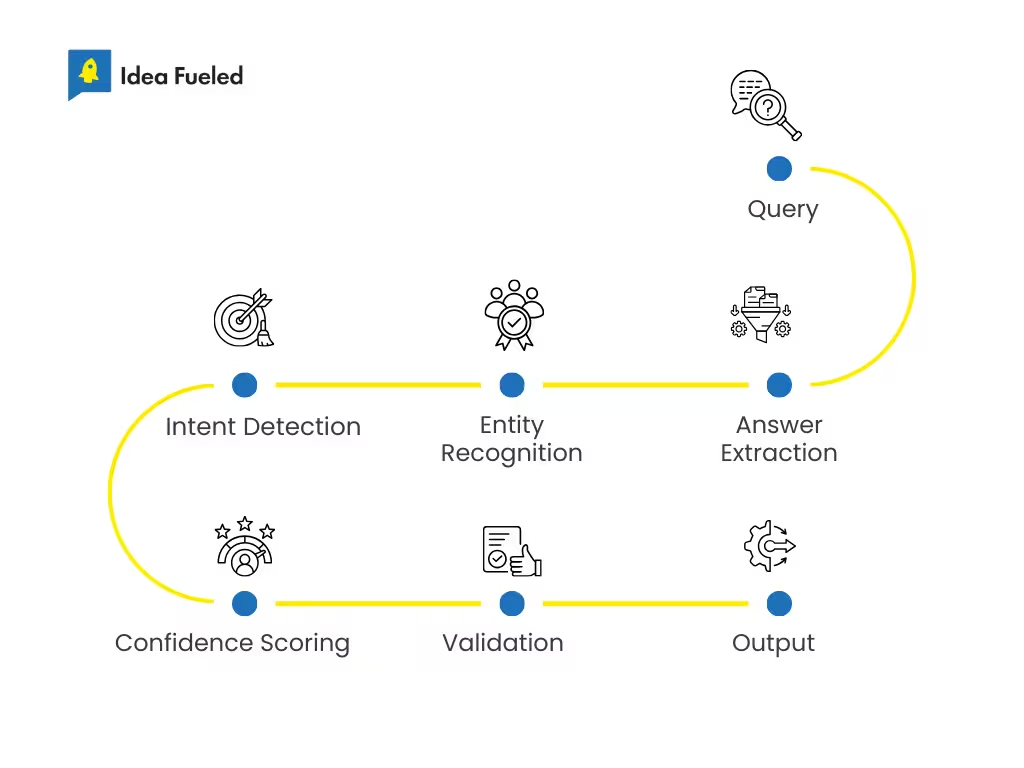
When a user types a question into an AI chat like ChatGPT or Gemini, the system isn’t scrolling through websites. It’s breaking the query into signals, evaluating answer candidates, and assembling a response it can confidently deliver. To understand how Answer Engine Optimization works, it helps to follow one question through the entire process.
Step 1: Query Interpretation and Intent Lock
Example query: “What is Answer Engine Optimization?”
The AI first determines intent. In this case, the intent is a definition, not a comparison, tutorial, or opinion. The system locks onto that intent and begins looking for content that directly explains the concept.
Pages that frame the topic clearly, use definition-style headings, and avoid mixed intent are aligned immediately. Content that starts with storytelling, trends, or abstract commentary creates friction at this stage.
Step 2: Entity Recognition and Context Framing
From the same query, the AI identifies core entities: Answer Engine Optimization, AEO, AI search, and its relationship to traditional SEO.
Content that explicitly defines Answer Engine Optimization, clarifies how it differs from SEO, and maintains consistent terminology becomes easier to contextualize. If a page alternates between vague phrases like “AI visibility” or “future search,” confidence drops.
This is where entity clarity quietly decides whether content is trusted or ignored.
Step 3: Answer Candidate Extraction
The system now looks for specific sections that can function as standalone answers to “What is Answer Engine Optimization?”
A short paragraph directly under a clear heading like “What Is Answer Engine Optimization (AEO)?” is ideal. The AI does not care about the rest of the page at this moment. It only cares whether that section can exist independently.
If the definition is buried three scrolls down, or blended into a long narrative, it often never becomes a candidate.
Step 4: Confidence and Clarity Scoring
Now the AI evaluates how cleanly that extracted section answers the question.
A strong candidate might define AEO in one or two sentences, explain its purpose, and stop. A weak one hedges, overqualifies, or delays the point. This is why concise answer blocks consistently outperform clever writing.
For AI search optimization, clarity beats complexity every time.
Step 5: Cross-Validation and Redundancy Checks
The AI compares that definition against other available explanations of Answer Engine Optimization.
If multiple sources describe AEO in similar terms, the confidence score increases. If one page frames it as a ranking hack while others frame it as content structuring for AI answers, the outlier loses.
Neutral, industry-aligned explanations survive this step. Opinion-heavy framing usually doesn’t.
Step 6: Tone, Safety, and Applicability Filtering
Before using the answer, the AI evaluates tone and intent.
If the definition is wrapped in sales language, hype, or self-promotion, it becomes less usable. Content written in a reference-style, instructional tone passes more easily because it feels safe to reuse in an AI-generated answer.
This is why AEO optimization discourages marketing language near core explanations.
Step 7: Answer Assembly and Output
Finally, the AI assembles the response. It may paraphrase the definition, combine it with supporting context, or merge multiple sources into one explanation.
At this point, the AI is not rewarding depth or originality. It is selecting content that was easy to extract, easy to validate, and easy to reuse.
What Content Principles Help AI Answer Engines Select Your Page?
AI answer engines select content that is easy to understand, easy to extract, and easy to validate. Pages built around clear questions, concise answers, and consistent terminology are more likely to be used in AI-generated responses. Let’s understand in detail with examples.
1. One Question, One Clear Answer
Example question: How is Answer Engine Optimization different from SEO?
AI systems work best when each section resolves a single intent. When multiple ideas are mixed into one answer, extraction becomes unreliable and confidence drops. AEO-friendly content isolates one question and closes it cleanly before expanding.
Good AEO-ready answer example:
Answer Engine Optimization focuses on structuring content so AI systems can extract and use it as a direct answer, while SEO focuses on improving rankings and visibility in search results. AEO prioritizes clarity and usability for AI, not clicks.
2. Answer First, Context Second
Example question: Why is Answer Engine Optimization important?
AI search systems favor content that delivers the conclusion immediately. When answers are delayed by background, trends, or framing, the system has to infer intent, which lowers selection confidence.
Good AEO-ready answer example:
Answer Engine Optimization is important because AI search systems deliver answers directly instead of directing users to pages. Content that is not structured for extraction is less likely to appear in AI-generated responses, regardless of ranking.
3. Concise Answer Blocks (40–60 Words)
Example question: What is the goal of AEO?
Short, complete answers are easier for AI models to reuse without distortion. Length is not the enemy. Ambiguity is. A focused answer that resolves the question fully is more valuable than a long explanation that wanders.
Good AEO-ready answer example:
The goal of Answer Engine Optimization is to make content easy for AI systems to understand, extract, and reuse as a direct answer. This is achieved by writing clear, concise responses that align with specific user questions.
4. Stable Terminology and Entity Consistency
Example question: What does AEO optimize for?
AI systems rely on consistent terminology to preserve meaning across a response. Switching labels or using loose synonyms forces the system to guess, which reduces trust in the answer.
Good AEO-ready answer example:
Answer Engine Optimization optimizes content for AI answer engines by improving clarity, structure, and extractability. AEO focuses on how content is interpreted and reused by AI systems, not on keyword density or rankings.
5. Neutral, Instructional Tone
Example question: How does AEO work in AI search?
AI models are conservative by design. They prefer content that explains rather than persuades. Instructional tone lowers risk and makes content safer to reuse in AI-generated answers.
Good AEO-ready answer example:
Answer Engine Optimization works by structuring content around clear questions and providing direct, factual answers. This approach helps AI systems identify reliable information and present it accurately to users.
6. Structural Signals That Support Extraction
Example question: How should content be structured for AI search?
Structure tells AI systems where answers begin and end. Clear headings, short paragraphs, and lists reduce interpretation effort and improve extraction accuracy.
Good AEO-ready answer example:
Content for AI search should be structured using clear question-based headings, concise paragraphs, and logical sections. This structure helps AI systems quickly locate and extract relevant answers without ambiguity.
Best Answer Engine Optimization strategies 2026
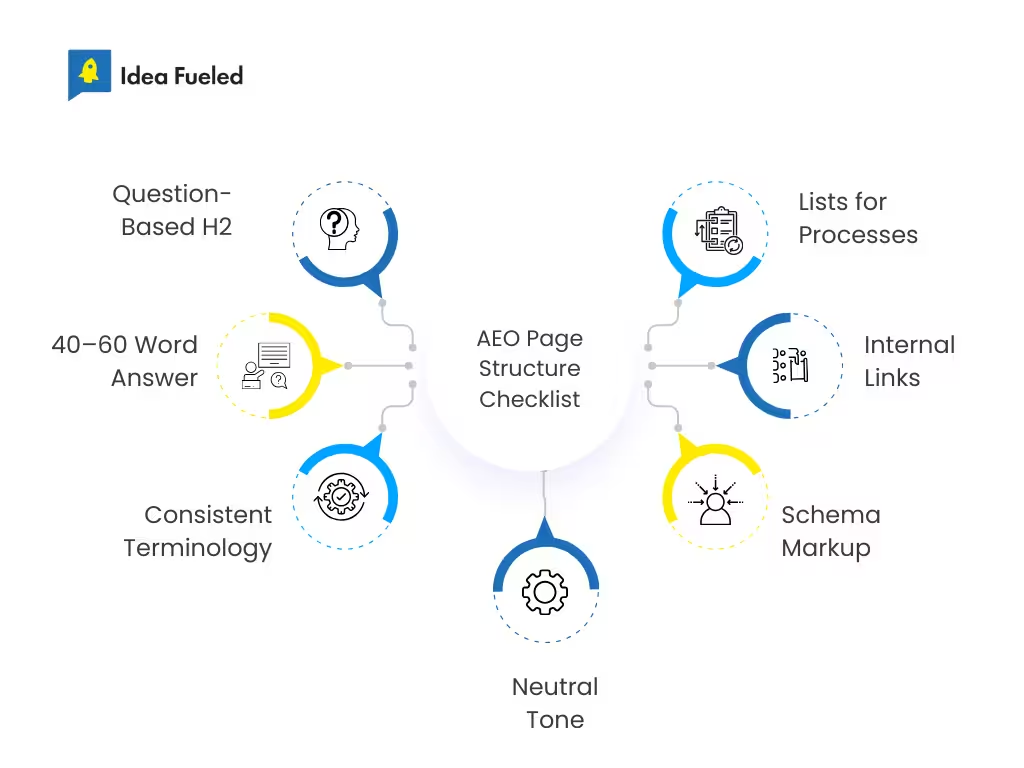
Now, to be cited by AIs, AEO practices must be strong. And for Answer Engine Optimization, on-page SEO elements matter when they help AI systems clearly identify intent, isolate answers, and understand context without interpretation. The focus shifts from ranking signals to answer usability.
| Headings That Signal Intent Clearly Headings play a critical role in AI search optimization because they help AI systems understand what each section is meant to answer. Clear, specific headings reduce ambiguity and improve answer extraction. Avoid clever phrasing or vague section titles. Headings should describe exactly what the section covers, using language that mirrors how users phrase questions in AI chats. |
| Paragraph Design for Answer Extraction AI answer engines often extract information at the paragraph level. Paragraphs that contain one clear idea and state it early are easier to reuse in AI-generated answers. Long, layered paragraphs force AI systems to infer meaning. Short, focused paragraphs reduce interpretation risk and increase selection confidence. |
| Use of Lists and Structured Formats Lists and structured formats help AI systems recognize patterns such as steps, criteria, or grouped information. This is especially important for process-driven and comparison-based queries. Well-structured lists improve clarity for humans and reduce processing effort for AI answer engines, making content more extractable and reliable. |
| Internal Linking for Context Reinforcement Internal links help AI systems understand how topics relate across a site. When content is connected logically, it strengthens entity context and topical authority. For AEO optimization, internal linking should reinforce meaning, not just distribute PageRank. Links should connect closely related concepts within the same content cluster. |
| Metadata That Clarifies, Not Sells Title tags and meta descriptions support AEO when they clearly state what the page answers. Over-optimization or click-driven language weakens clarity. Metadata should confirm topic relevance for AI-powered search systems, not attempt persuasion. |
| Formatting That Reduces Ambiguity Consistent formatting helps AI systems identify where answers begin and end. Clear spacing, predictable structure, and logical grouping all improve extraction accuracy. Formatting does not replace strong content, but poor formatting can prevent strong content from being used in AI search results. |
| Structured Data Through Schema Markup Structured data, implemented through schema markup, helps AI systems understand what your content represents and how different sections should be interpreted. It clarifies whether a block of content is a definition, a process, or a question-and-answer format. Schema markup does not improve rankings and does not guarantee AI citations. Its role in Answer Engine Optimization is supportive. It reinforces clarity for content that is already well-structured, making it easier for AI systems to confirm meaning and reuse information in AI-generated answers. |
Why Do These Elements Work Together?
These on-page SEO elements create the conditions required for Answer Engine Optimization to work at scale. They don’t replace traditional SEO fundamentals. They refine them for AI-driven search behavior.
How Do You Measure Answer Engine Optimization Success?
You measure Answer Engine Optimization (AEO) by tracking visibility and reuse, not rankings. AI answer engines don’t reward positions or clicks. They reward clarity and usefulness, which show up differently.
Ways to measure AEO success:
- Your content appears repeatedly in AI-generated answers for the same topic
- AI search tools reference your definitions, explanations, or frameworks
- Users arrive via AI-powered search with highly specific, high-intent queries
- The same page sections are surfaced across different AI answer engines
- Brand or concept mentions increase even without direct attribution
- AI-driven traffic converts faster due to clearer intent alignment
- Question-based queries align closely with your AI search optimization structure
Want Your Content to Show Up in AI Answers?
Ranking on Google is no longer enough. If AI systems can’t extract your content, you simply don’t exist in modern search.
At Idea Fueled, we apply practical Answer Engine Optimization frameworks to make your pages clear, structured, and reusable by AI answer engines like ChatGPT, Gemini, and Perplexity. From content architecture to schema markup for AEO visibility, we turn messy pages into answers AI can confidently cite.
Let’s optimize your content for AI search the right way.
Conclusion: Where AEO Actually Fits in Modern SEO
Answer Engine Optimization is not a new discipline replacing SEO. It’s the next layer on top of strong on-page SEO. If SEO helps content get discovered, AEO helps content get selected by AI search systems.
Optimizing for AI search, AI-generated answers, and AI answer engines comes down to one thing: usability. Clear questions. Direct answers. Stable terminology. Structure that removes guesswork. When content is easy for AI to understand and reuse, visibility follows naturally.
You don’t need new tools or shortcuts. You need discipline in how content is written, structured, and maintained. That’s what makes content future-ready for Answer Engine Optimization in 2026 and beyond.
Frequently Asked Questions (FAQs)
1. What is Answer Engine Optimization (AEO)?
Answer Engine Optimization is the practice of structuring content so AI answer engines can understand it, extract it, and reuse it in AI-generated answers. It focuses on clarity and answer usability, not rankings.
2. How is AEO different from SEO?
SEO optimizes content for discovery and rankings in search engines, while AEO optimizes content for selection and reuse in AI-powered search systems. SEO gets you indexed. AEO gets you quoted.
3. Does AEO replace traditional on-page SEO?
No. AEO depends on strong on-page SEO fundamentals. Without proper structure, crawlability, and relevance, content is unlikely to be eligible for AI answer selection.
4. Can schema markup help with AI citation?
Schema markup helps AI systems understand content structure and intent, but it does not guarantee AI citations. It supports clarity for content that is already optimized for AI search.
5. How long does it take to see AEO results?
AEO results are cumulative. Instead of immediate rankings, you’ll see repeated appearances in AI-generated answers, consistent phrasing reuse, and higher-intent AI-driven traffic over time.
6. Can you track AEO performance with tools?
You can’t track AEO directly, but tools like Google Search Console, analytics platforms, and AI search tools help identify visibility, reuse patterns, and AI-driven referral behavior.
7. Do AI answer engines always cite sources?
No. Some AI systems provide citations, others paraphrase without attribution. Lack of a visible link does not mean your content wasn’t used.