

The Current Reality: Everyone Is Using AI But Few Are Gaining an Advantage
Most teams using AI for SEO are publishing 3× more content and seeing 0 meaningful ranking growth. Content velocity has increased, but organic traffic per page is declining.
Why? Because producing faster versions of the same article does not create new visibility. It just increases index bloat, dilutes internal linking equity, and accelerates content decay.
It costs you:
- More output, but higher cost per ranking page
- Faster publishing, but lower average time on page
- Full content calendars, but no movement in competitive SERPs
Now compare that to teams using AI as a strategic layer. They are:
- Expanding topical coverage in weeks instead of quarters
- Reducing research time by more than 50%
- Turning subject-matter expertise into scalable, search-driven assets
Same technology but completely different outcome. Thus, the real divide is no longer AI vs human content. It is:
- AI used for just production with sameness will lead to flat growth
- AI used for strategy and velocity with differentiation will lead to compounding organic visibility
That single shift determines whether AI content generation for SEO becomes a growth engine or a ceiling on your rankings.
What You’ll Learn?
- Where AI content generation for SEO actually creates a ranking advantage and where it quietly destroys it.
- The real reason most AI-written articles fail to move positions in competitive SERPs.
- How to use AI to scale research, topical coverage, and content velocity without losing authority.
- A practical workflow that separates production efficiency from strategic differentiation.
- The exact role humans must play to build EEAT, links, and brand-level visibility.
- When to automate content and when human-led creation is non-negotiable.
- A maturity model to benchmark your current AI SEO content capability.
- How to turn AI from a writing shortcut into a compounding organic growth system.
- What changes as AI search and answer engines start selecting which sources to cite.
The Real Pros of AI Content for SEO

AI content delivers its biggest SEO gains when it is used to remove production bottlenecks, not strategic thinking. The real advantage of AI SEO content lies in scaling research, accelerating workflows, and expanding search coverage without diluting quality.
1. Search coverage at a speed humans alone cannot match
AI SEO content is unmatched for building topical clusters, programmatic supporting content, and long-tail query coverage. A SaaS company expanding into a new category can map 200 intent variations, generate structured first drafts, and create a full topic layer in weeks instead of months.
This is not about publishing all of it instantly. It’s about removing the production bottleneck from the strategy.
2. Research compression
AI turns a 6-hour research phase into a 45-minute synthesis process. If used properly, it can summarize SERPs, extract common subtopics, identify content gaps, and cluster search intent. That allows strategists to spend their time on angle, differentiation, and positioning, which are the actual ranking levers.
3. Content operations scalability
For agencies and in-house teams, AI helps in faster briefs, structured outlines, refresh workflows, and multi-format repurposing. This is where AI content strategy becomes an operational advantage, not a writing shortcut.
4. Data-to-content transformation
AI is exceptional at turning raw inputs into usable content:
- product documentation – SEO pages
- webinar transcripts – thought leadership
- internal SME interviews – structured articles
That is a defensible use case because the source material is unique.
The Real Cons of AI Content for SEO

The common “AI lacks creativity” is shallow. Because the real problems are structural.
1. Ranking sameness
AI mirrors the web’s existing consensus. In simple words, if the top 20 results say similar things, your AI-generated article will too. That creates zero information gain, and no reason for Google to re-rank the SERP
2. No lived experience is equal to weak EEAT signals
AI cannot run experiments, share failures, reference internal data, and provide field insights. And those are precisely the elements that now differentiate top-ranking content.
3. Factual confidence without factual reliability
AI produces clean, authoritative language even when the underlying claim is wrong or outdated. That creates hidden risk for YMYL topics, product comparisons, and technical SEO guidance. One incorrect assertion in a high-intent article can destroy trust and conversions.
4. Brand voice erosion at scale
When every piece is generated from similar prompts, the brand becomes indistinguishable from competitors using the same workflow. You might gain output but lose identity.
Why Most AI Content Fails to Rank?
Most AI content fail because it lacks E-E-A-T, leading to generic, formulaic information that lacks value. The issue is not that Google “detects AI.” The issue is that Google detects lack of value. At a pattern level, low-performing AI content:
- is derivative of existing SERPs
- answers the query but adds nothing new
- has no proprietary insight
- targets keywords without owning a perspective
Search engines are neutral when it comes to rank content for being correct. They rank it for being the most useful result among many similar ones.
So, if your workflow is: SERP – AI draft – light edit – publish. Then you are training your own irrelevance and down graph.
How to Use AI for SEO Content: A Practical Workflow

To use AI for SEO content without being labeled as spam Violation. Also to be cited by AI through Answer Engine Optimization (AEO). Follow these practical workflow:
1. Research and Intent Modeling
Use AI to process scale, not to replace thinking. It can cluster large keyword sets, extract common SERP structures, and reveal intent patterns in minutes. The human role is to define the angle competitors are missing. Without that information gain, faster research only produces faster sameness.
2. Strategic Outlining
AI should generate the structural base of the article, ensuring full topical coverage. The differentiation happens when humans inject POV, product relevance, real scenarios, and conversion paths into that outline. A unique outline almost always leads to a unique ranking outcome.
3. First Draft Acceleration
AI removes the blank-page problem by turning bullet points into a coherent draft. This shifts human effort from writing volume to strengthening arguments, refining clarity, and adding depth. The draft is a starting point, not the asset.
4. The Human Differentiation Layer
This is where rankings are won. Add original insights, internal data, real workflows, expert commentary, and experience-driven examples. These elements create EEAT, increase linkability, and give search engines a reason to rank the page above structurally similar content.
5. Optimization and Search Packaging
AI is highly effective at semantic enrichment, FAQ generation, and featured-snippet formatting. Its real value here is making content extractable for both search engines and AI answer systems. The strategic decision about what the page should be known for must remain human.
Human vs AI Content SEO: What Should Never Be Automated
Some elements are defensible only when they come from humans such as:
- Original research
- Strategic opinion
- Product narrative
- Case studies
- Experience-based frameworks
- Category point of view
These are the parts that earn links, mentions, and brand recall. Simply put, automate production but never automate authority.
The AI Content Strategy Maturity Model
| Category | Beginner (AI as a Writing Tool) | Intermediate (AI as a Production System) | Advanced (AI as a Strategic Amplifier) |
| How AI is used | Full article generation from prompts with minimal modification | Keyword clustering, briefs, outlines, refresh workflows, first-draft acceleration | Intent modeling at scale, SERP gap analysis, lifecycle automation, semantic optimization |
| Human role | Basic proofreading and readability edits | Brand voice alignment, intent matching, structural improvements | Creating original frameworks, adding real scenarios, defining positioning, revenue alignment |
| Content characteristics | Generic, mirrors existing SERPs, no clear POV or proprietary insight | Stronger structure, consistent publishing, broader topical coverage | High information gain, experience-driven, citation-worthy, tightly connected to product and category narrative |
| SEO impact | Indexation without meaningful ranking growth; traffic volatility | Long-tail visibility improves, early topical authority signals, steady traffic lift | Stable rankings in competitive SERPs, higher conversion from organic, natural links and mentions |
| Operational limitation | Scale without differentiation; fast content decay | Competing on completeness rather than uniqueness | Requires deep SEO–content–product collaboration |
| What unlocks the next stage | Move AI from writing to research and outlining | Inject SME insight, internal data, product POV, and real-world workflows | Build proprietary data loops and continuous insight generation tied to business strategy |
Uniqueness Layer for AI SEO content: Original Frameworks & Mental Models
These models are not theoretical. They reflect how high-performing SEO teams use AI to scale output without sacrificing authority, differentiation, or conversions.
1. The Information Gain Stack
Ranking today is driven by how much new value a page adds compared to everything already in the SERP. The Information Gain Stack breaks this into five progressive layers:
- Intent match: the page satisfies the core query
- Topical completeness: all expected subtopics are covered
- Experience signals: real workflows, use cases, or observations
- Original insight: a perspective not repeated across competing pages
- Strategic POV: a clear, defensible point of view tied to your expertise
Most AI-generated content reaches the second layer and stops. Pages that rank consistently operate in layers four and five, where differentiation and authority are built.
2. The Human Differentiation Layer
AI accelerates structure and production, but it cannot create credibility. The Human Differentiation Layer is the stage where subject-matter expertise turns a generated draft into a ranking asset. This includes:
- real performance data and outcomes
- first-hand implementation learnings
- product-connected scenarios
- expert commentary and strong opinions
Without this layer, content may be accurate and well-structured, but it remains interchangeable with dozens of competing results. With it, the page becomes cite-worthy, linkable, and conversion-focused.
3. The Scale–Depth Curve
Not every content type requires the same level of human effort. The Scale–Depth Curve helps teams decide where AI should lead and where humans must take full control.
- High scale, low differentiation: supporting articles, long-tail expansions, content refreshes – AI-assisted production
- Balanced scale and depth: commercial blogs, solution-led content – hybrid workflow
- Low scale, maximum authority: pillar pages, original research, category-defining content – human-led creation
This prevents the most common operational mistake: applying one production model to every page and diluting overall performance.
4. The SERP Sameness Trap
When multiple teams use AI on the same sources, follow the same outlines, and target the same keywords, they produce structurally identical content. The result is perfect relevance with no ranking movement.
Escaping the SERP Sameness Trap does not require better prompts. It requires a unique angle, experience-backed insights, and content that reflects real execution, not summarised consensus.
Does AI Content Rank on Google? Yes — But with Conditions.
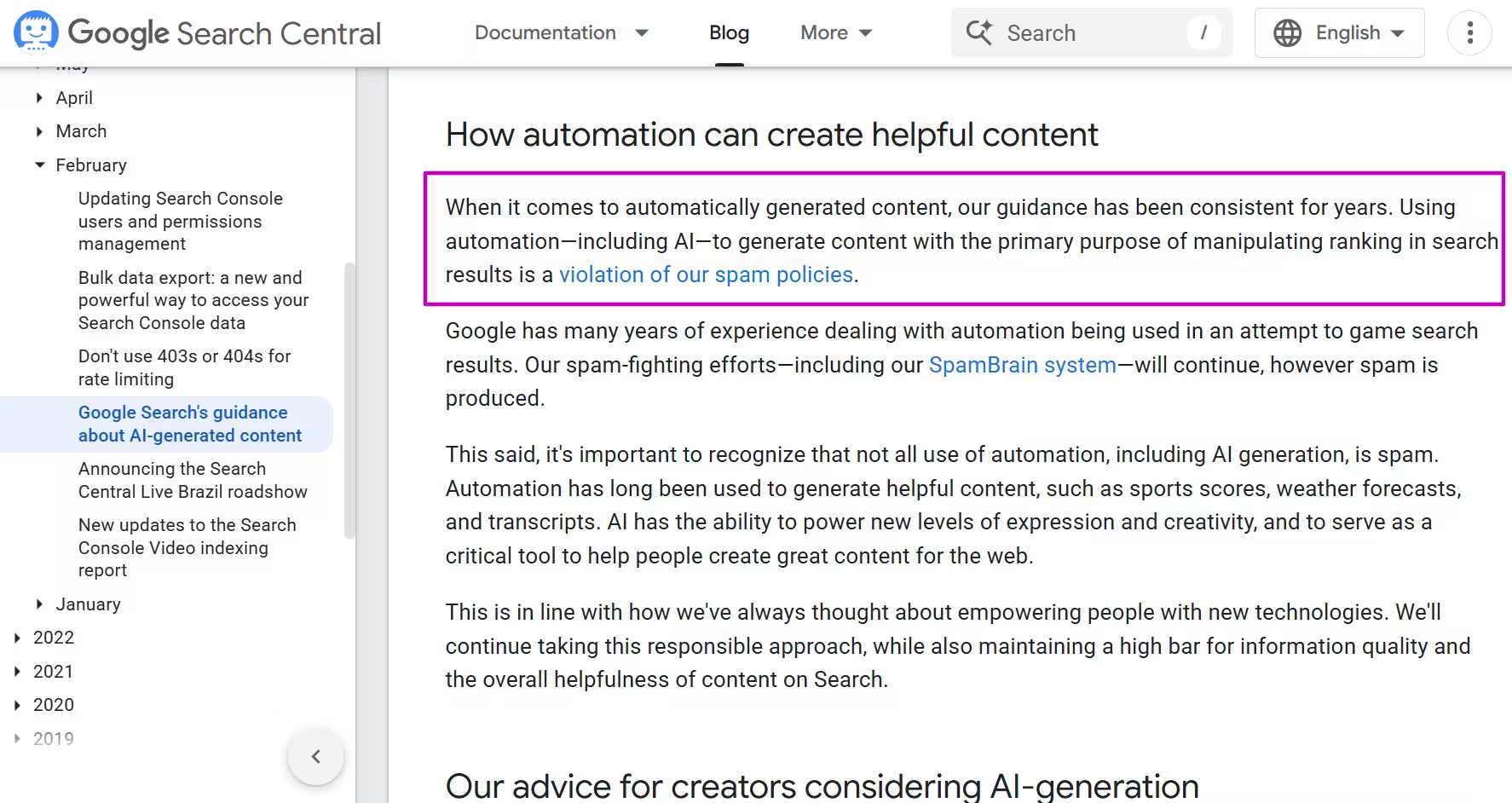
Google is very clear towards its policy. It directly states,
“Using automation—including AI—to generate content with the primary purpose of manipulating ranking in search results is a violation of our spam policies.”
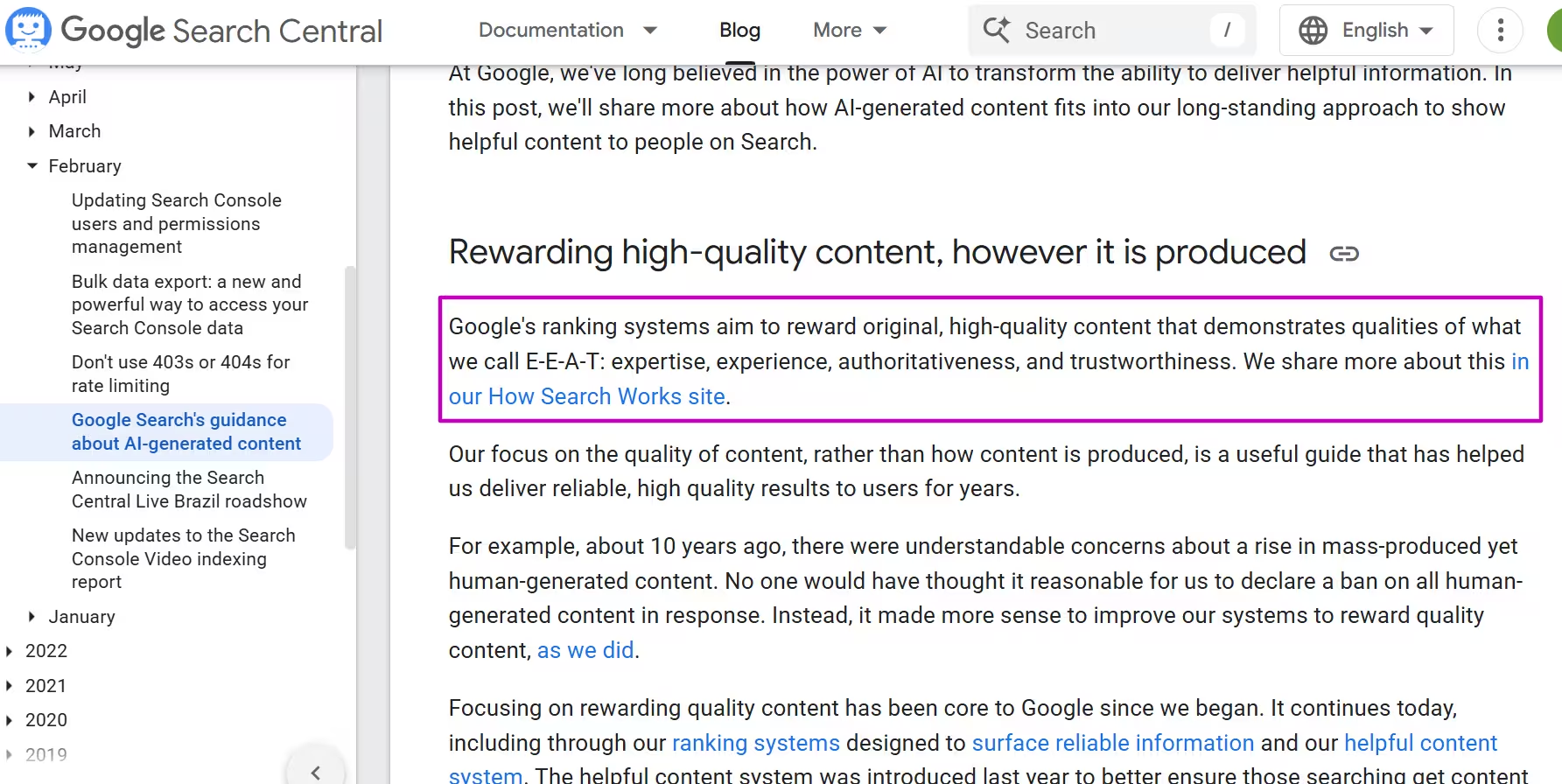
But here’s a loophole Google provides themselves, They say,
“Google’s ranking systems aim to reward original, high-quality content that demonstrates qualities of what we call E-E-A-T: expertise, experience, authoritativeness, and trustworthiness. We share more about this in our How Search Works site.”
So, does AI content rank on google? Yes, AI content ranks on google when:
- the topic fit is strong
- the information gain is real
- the page satisfies intent better than alternatives
Remember one simple rule: The generation method is irrelevant. The value delta is everything.
Let Idea Fueled Help You Create Content That Google Loves
If your team is producing more content but seeing diminishing ranking returns, the issue is not AI adoption, it’s the absence of a differentiated SEO content system. We, at Idea Fueled, help marketing teams turn AI into a strategic growth layer by combining search intelligence, proprietary frameworks, and human-led authority building.
Conclusion
AI content generation for SEO is neither a shortcut nor a threat. It is a multiplier. Used for production alone, it creates scale without impact. Used for research, coverage, and workflow acceleration, it frees humans to do the only things that actually rank, that includes building authority, introducing new perspectives, connecting content to real expertise
The teams winning with AI are not the ones publishing the most. They are the ones adding the most new value per page. That is the real competitive model for AI-assisted SEO.
Frequently Asked Questions (FAQs)
1. Does AI content rank on Google?
Yes, AI content ranks on Google when it satisfies search intent, demonstrates accuracy, and adds information gain beyond existing results. Google evaluates content based on quality and usefulness, not the production method. Pages that combine AI-assisted structure with human expertise, original insights, and clear topical relevance consistently outperform generic AI-generated articles.
2. Is AI content good for SEO?
AI content is effective for SEO when it is used to scale research, expand topical coverage, and accelerate content workflows. It becomes ineffective when it produces repetitive pages with no unique perspective. The ranking impact depends on differentiation, credibility signals, and alignment with search intent.
3. What are the pros and cons of AI content for SEO?
The main advantage of AI SEO content is speed, scalability, and the ability to process large datasets for keyword clustering and content planning. The key limitations are lack of real-world experience, factual risk, and producing content that closely resembles competing pages. AI improves efficiency, but authority still requires human input.
4. How do you use AI for SEO content without hurting rankings?
Use AI for SERP analysis, outlining, and first-draft generation, then apply a human differentiation layer that adds real examples, product relevance, expert insights, and a clear point of view. This hybrid model maintains content velocity while ensuring the page delivers unique value that search engines can rank.
5. Can AI-generated content impact EEAT?
AI-generated content supports EEAT when it is guided by subject-matter expertise, includes verifiable insights, and reflects real experience. It weakens EEAT when it publishes unverified claims or removes the human expertise behind the content. EEAT is built through credible contributors and original value, not the writing method.
6. Is human-written content better than AI content for SEO?
Human-written content performs better when authority, trust, and original thinking are required. AI-assisted content performs better for scale, structuring, and data processing. The strongest SEO results come from a hybrid workflow where AI accelerates production and humans create differentiation.