

Did you know that narrative-based websites and campaigns can boost brand recall and engagement by roughly 50%? In fact, a study by Neuro-insights explains that those ads told as stories can raise purchase intent by up to 30%. That is the power of brand storytelling frameworks.
Many psychological studies reveal that customers remember information far better when it is conveyed in story form rather than simple, plain facts. This happens because stories activate multiple parts of the brain at once, including areas responsible for emotion, memory, and meaning. When people feel something, they remember it. That is the core reason why storytelling works in branding, and why facts alone rarely make a brand stick.
For B2C brands especially, attention is fragile, and choice overload is real. Customers are not comparing feature lists. They are subconsciously asking, Is this brand for people like me? A strong brand storytelling strategy answers that question instantly by placing the customer at the center of the narrative, not the product or the founder.
This is where brand storytelling frameworks come in. In this blog, we break down the most effective brand storytelling frameworks used by successful B2C brands, how they apply to website content, and how customer-centric storytelling makes brands instantly memorable.
What Will You Learn?
- What brand storytelling frameworks actually are and why they work better than traditional brand messaging.
- The psychological principles behind brand storytelling that explain why customers remember stories, not slogans.
- How leading B2C brands use customer-centric storytelling to structure their website content.
- Which brand narrative framework fits different business goals, audiences, and stages of growth.
- How storytelling in marketing goes beyond creativity and becomes a repeatable brand storytelling strategy.
Why Does Storytelling Work So Well in Branding?
Storytelling works in branding because the human brain is wired to process, remember, and trust information delivered as a story rather than isolated facts. Stories activate emotion, attention, and memory at the same time, which makes brands easier to recall and harder to ignore. From a psychological standpoint, this happens for three core reasons.
- Stories Trigger Emotional Processing
When a narrative introduces a problem, tension, or aspiration, the brain releases dopamine, which improves focus and memory retention. This is why people remember brand stories days later but forget feature lists within minutes. Emotional engagement is the foundation of recall, not repetition.
- Stories Create Identification
In effective B2C brand storytelling, customers subconsciously place themselves inside the narrative. When the brand reflects their struggles, desires, or values, the brain treats the story as personally relevant. This self-referencing effect is a key psychological principle behind brand storytelling and explains why customer-centric storytelling consistently outperforms brand-centric messaging.
- Stories Build Meaning, not just information.
Facts answer what. Stories answer why it matters. Research in cognitive psychology shows that people understand and retain information better when it is connected to cause, effect, and outcome. A strong brand narrative framework does exactly this by linking a customer’s problem to a clear resolution.
This is why storytelling in marketing is not a creative trend but a strategic tool. Brands that rely only on claims, features, or generic positioning force customers to do the mental work. Brands that use a clear brand storytelling strategy guide the brain naturally from attention to understanding to trust.
And once trust is established, memorability follows.
Why Do Most Brand Stories Fail to Be Memorable?
Most brand stories fail because they focus on the brand instead of the customer. They ignore how people think, feel, and remember information. The most common reasons this happens are:
- The brand makes itself the hero
In weak B2C brand storytelling, the brand talks about its vision, achievements, and features. Psychologically, this creates distance. People engage more when they can see themselves in the story. Customer-centric storytelling fixes this by making the customer the main character.
- There is no clear storytelling framework
Many brands attempt storytelling in marketing without using a defined brand storytelling framework. Without structure, the narrative feels scattered, making it harder for the brain to follow and remember.
- The message is too abstract to feel real
Generic phrases like “we innovate” or “we care” lack emotional weight. The brain responds better to concrete situations and relatable experiences, which is why a strong brand narrative framework matters.
- Storytelling is treated as decoration, not strategy
Brands often add a story after writing their messaging. A real brand storytelling strategy works in reverse. The story shapes the messaging from the start.
- The customer’s emotional journey is ignored
When brands skip tension, struggle, or transformation, the story feels flat. Psychological principles behind brand storytelling show that emotion and change are essential for memorability.
This is why brands that rely on random creativity fade quickly, while those using structured, customer-centric storytelling stay remembered.
6 Brand Storytelling Frameworks Used by Billion-Dollar Brands
The most effective brand storytelling frameworks give structure to how a brand presents a problem, builds an emotional connection, and positions itself as the solution. They work because they align with how the brain expects stories to unfold.
Without a framework, storytelling in marketing becomes scattered. With one, it becomes repeatable, clear, and persuasive. Below are the brand storytelling frameworks most commonly used by successful B2C brands, especially on websites.

- The Pixar Story Spine
- The Golden Circle Framework
- The StoryBrand Framework
- The Hero’s Journey
- The Three-Act Structure
- The ABT Framework (And–But–Therefore)
1. The Pixar Story Spine: Making Change Easy to Remember

The Pixar framework is designed to explain change in a simple, emotionally engaging way. It works especially well for brands introducing a new idea, category, or way of doing things.
Structure:
- Once upon a time… (the status quo)
- Every day… (the routine problem)
- One day… (the disruption)
- Because of that… (consequences)
- Until finally… (resolution)
This framework is powerful for website storytelling because it mirrors how customers experience change in real life. Linear stories reduce cognitive load, which improves comprehension and recall. That is why this framework is often used on homepage narratives and explainer sections.
Best used when:
- Introducing a new product or category
- Explaining “why things need to change.”
- Simplifying complex ideas for mass audiences
2. The Golden Circle: Leading With Purpose Before Product
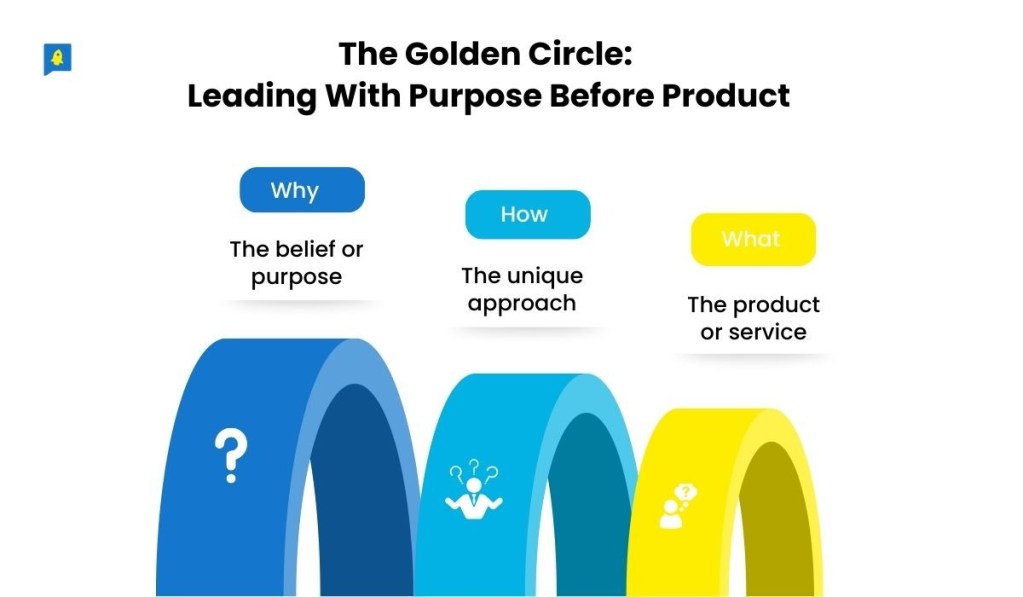
Simon Sinek’s Golden Circle flips traditional messaging by starting with why instead of what.
Structure:
- Why: The belief or purpose
- How: The unique approach
- What: The product or service
This framework works because people emotionally connect with purpose before logic kicks in. Psychologically, values-based storytelling creates trust and identification, which is critical in B2C brand storytelling where emotional alignment drives decisions.
On websites, the Golden Circle often shows up in brand positioning statements and “About Us” sections. Apple is the most cited example, but many modern DTC brands use this approach to differentiate in crowded markets.
Best used when:
- Building belief and loyalty
- Differentiating beyond features
- Communicating brand purpose clearly
3. The StoryBrand Framework: Customer as the Hero
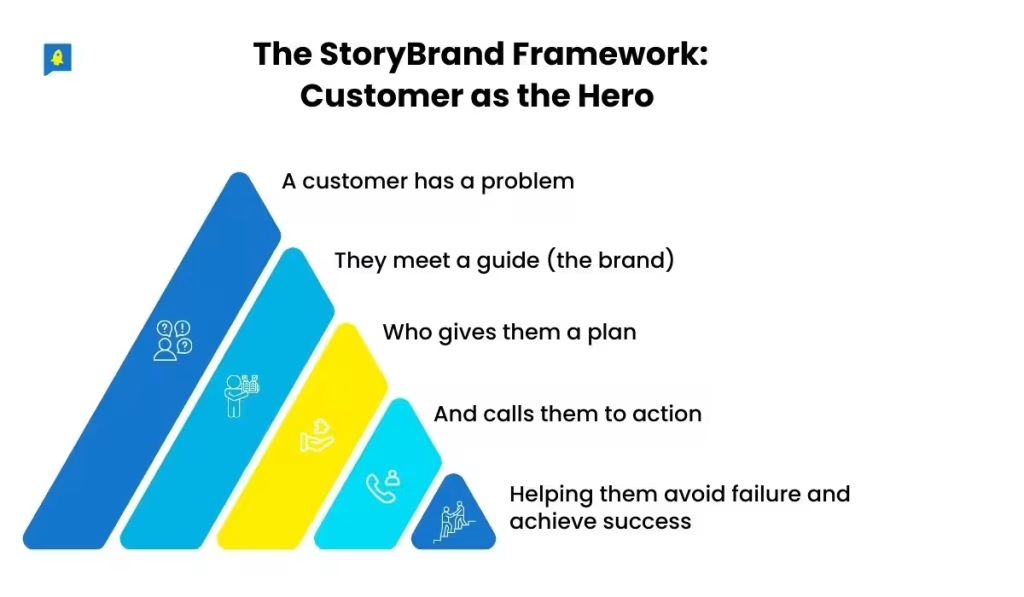
The StoryBrand framework is one of the most effective brand storytelling frameworks for websites because it is ruthlessly clear. The core idea is that the customer is the hero. The brand is the guide.
Structure:
- A customer has a problem
- They meet a guide (the brand)
- Who gives them a plan
- And calls them to action
- Helping them avoid failure and achieve success
This framework aligns perfectly with customer-centric storytelling. It reduces confusion, positions the brand as helpful rather than boastful, and makes the next step obvious. From a psychological standpoint, clarity lowers resistance and increases conversion. This is why StoryBrand is widely used in homepage copy, landing pages, and service pages for B2C brands.
Best used when:
- Website clarity is the priority
- Conversion matters more than drama
- The audience is problem-aware but solution-confused
4. The Hero’s Journey: Transformation-Focused Brand Stories

The Hero’s Journey is the classic transformation arc. In branding, it is most effective when adapted so that the customer experiences the journey, not the brand. This framework works because humans are wired to look for growth and transformation in stories. Struggle followed by change is what makes narratives emotionally satisfying and memorable.
In B2C branding, this framework is commonly used for founder stories, lifestyle brands, fitness, wellness, and personal growth narratives where before-and-after transformation is central.
Best used when:
- Telling founder or origin stories
- Highlighting long-term transformation
- Building emotional depth and inspiration
5. The Three-Act Structure: Clear, Logical Story Flow
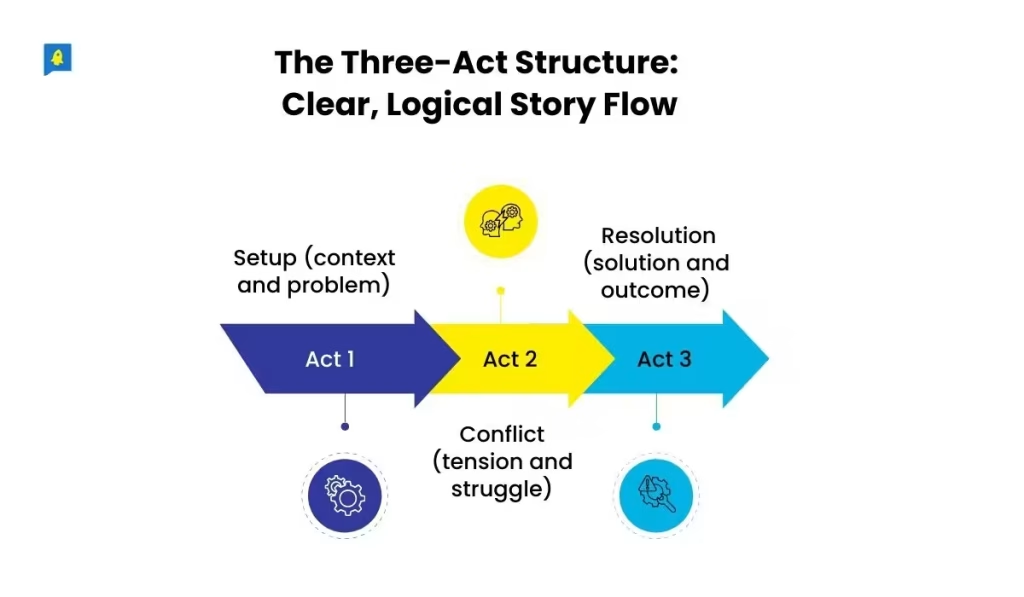
The three-act structure is the backbone of most storytelling.
Structure:
- Act 1: Setup (context and problem)
- Act 2: Conflict (tension and struggle)
- Act 3: Resolution (solution and outcome)
This framework works because the brain expects information to flow this way. It is especially effective for long-form website pages, case studies, and landing pages where a guided journey improves engagement. From a storytelling in marketing perspective, this structure ensures the reader never feels lost.
Best used when:
- Structuring long pages
- Building logical momentum
- Educating while persuading
6. ABT (And, But, Therefore): Fast and Persuasive Messaging

The ABT framework is a minimalist storytelling structure designed for clarity and persuasion.
Structure:
- And: Context
- But: Problem or tension
- Therefore: Resolution
While simple, it is powerful for micro-storytelling. On websites, ABT works well in headlines, sub-sections, and value propositions where attention spans are short.
Best used when:
- Writing hero sections and headlines
- Creating punchy brand statements
- Explaining value quickly
Each of these brand storytelling frameworks serves a different purpose, but all succeed for the same reason: they respect how the human brain processes stories. The right framework does not make a brand creative. It makes the brand understandable.
How To Choose the Right Brand Storytelling Framework for Your Brand?
You choose the right brand storytelling framework based on your goal, audience awareness, and where the story will live on your website. Not every framework works for every brand or every page. Using the wrong one creates confusion, not memorability. Different frameworks solve different storytelling problems. The table below simplifies that choice.
| Brand Goal / Use Case | Best-Fit Storytelling Framework | Why It Works |
| Homepage clarity and conversions | StoryBrand Framework | Makes the customer the hero and the brand the guide, reducing confusion and increasing action |
| Explaining a new idea or change | Pixar Story Spine | Linear storytelling helps the brain understand and remember change |
| Building emotional transformation | Hero’s Journey | Focuses on struggle and growth, which strengthens emotional recall |
| Communicating brand purpose | Golden Circle | Starts with “why,” creating belief before logic |
| Structuring long website pages | Three-Act Structure | Guides readers logically from problem to resolution |
| Headlines and quick value messaging | ABT Framework | Delivers clarity fast with minimal cognitive load |
How to Think About This Strategically?
Choosing a brand storytelling strategy is not about preference. It is about alignment.
- If your audience is confused, use clarity-first frameworks like StoryBrand or ABT.
- If emotional trust and belief matter most, the Golden Circle or Hero’s Journey is stronger.
- If your audience understands the problem but not the value, Pixar or Three-Act works better.
In B2C brand storytelling, memorability comes from relevance, not complexity. The right brand narrative framework helps your audience instantly understand where they fit in the story and why your brand matters to them. That is the real reason frameworks work. They remove friction from understanding.
Some Real Examples of Brand Storytelling
Memorable brands use storytelling frameworks to make their message instantly clear, emotionally relevant, and easy to recall. They do not rely on clever copy alone. They rely on structure. Here are clear examples of how B2C brands apply brand storytelling frameworks in practice, especially on their websites and campaigns.
Note: These brands do not “tell stories” through long homepage or website content. Their storytelling happens through campaigns, visuals, messaging, and brand positioning. Use the examples below to understand how the story is structured, not where it is written.
- Nike: Hero’s Journey in Action
Nike’s brand storytelling consistently places the customer in a transformation arc. The story is never about Nike as a company. It is about ordinary people pushing through struggle and becoming stronger versions of themselves.
This is a textbook Hero’s Journey adapted for B2C brand storytelling. The challenge, effort, setback, and eventual breakthrough are always visible. Psychologically, this works because transformation is what the brain finds most emotionally satisfying and memorable.
Nike’s website, campaigns, and product messaging all reinforce this narrative of personal victory.
- Airbnb: Customer-Centric Storytelling at Scale
Airbnb uses customer-centric storytelling by showcasing hosts and travelers as the heroes of its brand narrative. The platform positions itself as the guide that enables meaningful experiences, not as the center of attention.
This approach aligns closely with the StoryBrand framework. The problem is generic travel, the guide is Airbnb, and the success is belonging anywhere. This clarity explains why Airbnb’s storytelling feels human and trustworthy instead of transactional.
Their website structure reinforces this story through visuals, copy, and real user experiences.
- Apple: Golden Circle Done Right
Apple’s storytelling rarely starts with product features. It starts with belief. Using the Golden Circle framework, Apple consistently leads with why it exists, then explains how it thinks differently, and only then introduces what it sells. This approach builds emotional alignment before logic enters the conversation.
From a psychological standpoint, this strengthens trust and loyalty. People feel connected to the belief system before evaluating the product. Apple’s website and product launches reflect this purpose-first storytelling strategy.
- Allbirds: Pixar Story Spine for Brand Change
Allbirds uses a simple, linear story to explain sustainability without overwhelming its audience. The narrative shows how traditional footwear harms the environment, introduces a different approach, and resolves the story with better materials and transparency.
This mirrors the Pixar Story Spine, making complex sustainability topics easier to understand and remember. Linear storytelling reduces mental effort, which is critical in B2C brand storytelling. Their website reinforces this story across product pages and brand content.
- TOMS: Three-Act Structure for Purpose-Driven Branding
TOMS built its brand using a clear Three-Act Structure.
- Act one: a world where basic needs are unmet
- Act two: awareness of the problem
- Act three: a brand that enables customers to create change through purchase
This structure made the brand’s purpose easy to grasp and emotionally compelling. The transformation is simple and memorable, which is why TOMS became a reference point for cause-driven branding.
Does Storytelling Work Only on Websites or Across All Marketing Channels?
Storytelling works across all marketing channels because the framework stays the same, even when the format changes. Only the execution shifts, not the narrative logic.
On social media, brands use compressed storytelling frameworks like ABT or StoryBrand through short videos, carousels, and hooks. Each post reinforces a single part of the larger story, helping build familiarity and recall.
In email marketing, storytelling unfolds over time. Frameworks such as the Three-Act Structure guide sequences that move from problem to trust to action, mirroring how people naturally make decisions.
Video and campaigns are where brand storytelling frameworks are expressed most fully. Brands often use the Hero’s Journey or Pixar Story Spine to create emotional impact, while the website supports conversion rather than explanation.
This consistency across channels is why storytelling in marketing works. When the same brand narrative framework appears everywhere, the brain recognizes it, trusts it, and remembers it.
Turn Your Brand Story Into Something People Actually Remember With Idea Fueled
Most brands have a clarity problem. They post content, run campaigns, redesign websites and still sound like everyone else. Not because they lack effort, but because there’s no structure behind the story.
At Idea Fueled, we don’t add storytelling as decoration. We build it into the foundation of your brand. We help B2C brands:
- define a clear brand narrative framework
- structure website messaging around customer-centric storytelling
- align positioning, copy, and UX with one consistent story
- turn scattered messaging into memorable, conversion-focused journeys
The result is simple: People understand you faster, trust you sooner, and remember you longer. If your brand sounds fine but forgettable, it’s time to fix the story, not the slogans. That’s exactly what we do at IdeaFueled.
Conclusion
Always remember this: Brands are not remembered because they are loud. They are remembered because their story is clear. That clarity is what brand storytelling frameworks provide.
Storytelling works in branding because it aligns with how people think, feel, and remember. When B2C brands use a structured, customer-centric storytelling approach, they reduce confusion, build emotional relevance, and create meaning that lasts beyond a single interaction.
The most successful brands do not rely on random creativity. They use a deliberate brand storytelling strategy supported by proven brand narrative frameworks. Whether the story appears on a website, in a campaign, or across multiple channels, the framework ensures consistency and memorability.
In a crowded digital world, attention is temporary. Stories are not. And the brands that understand this are the ones people remember without trying.
Frequently Asked Questions (FAQs)
1. What are brand storytelling frameworks?
Brand storytelling frameworks are structured models that help brands communicate their message through clear, memorable narratives. They guide how a brand presents problems, emotions, and solutions so customers can easily understand and remember the story.
2. Why are storytelling frameworks important for branding?
Storytelling frameworks are important because they align brand messaging with how the human brain processes and remembers information. They reduce confusion, increase emotional connection, and improve brand recall compared to unstructured messaging.
3. How do storytelling frameworks help B2C brands?
Storytelling frameworks help B2C brands make customers feel personally connected to the brand. By using customer-centric storytelling, brands position the customer as the hero and themselves as the guide, which increases trust and engagement.
4. Which brand storytelling framework is best for websites?
The StoryBrand framework is most effective for websites focused on clarity and conversion. It clearly defines the customer’s problem, positions the brand as the guide, and leads users toward a clear call to action.
5. Can storytelling frameworks work without long website content?
Yes, storytelling frameworks work even when websites are product-focused. In large B2C brands, the storytelling framework shapes campaigns, visuals, headlines, and brand positioning rather than appearing as long-form copy.
6. How does psychology support brand storytelling?
Psychology supports brand storytelling because stories activate emotion, memory, and attention simultaneously. This makes storytelling more effective than facts alone, which explains why storytelling works in branding.
7. Is storytelling only useful for marketing campaigns?
No, storytelling is useful across websites, emails, social media, and video. A strong brand storytelling strategy ensures the same narrative logic is applied consistently across all channels.
8. What is customer-centric storytelling?
Customer-centric storytelling places the customer at the center of the brand narrative. Instead of focusing on the brand’s achievements, it highlights the customer’s problem, journey, and transformation.
9. How do I choose the right storytelling framework for my brand?
Choose a storytelling framework based on your brand’s goal, audience awareness, and where the story appears. For clarity and conversion, use StoryBrand or ABT. For emotional depth, use Hero’s Journey or Pixar Story Spine.
10. Do small brands need storytelling frameworks too?
Yes, small brands benefit even more from storytelling frameworks. Frameworks help emerging brands sound clear, confident, and memorable without relying on large budgets or brand recognition.