

If your SaaS blog gets thousands of visitors, but the demo calendar stays empty. It’s most likely a content marketing problem.
And that gap between traffic and revenue is not a content problem. It is a strategy problem. You published consistently. You optimized your titles. You even built a few backlinks. But visitors landed, read, and left. They never converted. The content did not match their buying intent.
Content marketing for SaaS is not about volume. It is about precision.
According to the Demand Gen Report B2B Content Preferences Survey, 61% of B2B buyers read 3 to 7 content pieces before talking to a salesperson. Your content must earn a place in that short stack. Most SaaS content never does.
The root cause is simple. Most SaaS teams write for the algorithm, not the buyer. They target impressions instead of intent.
This blog shows you the full system. You will learn to build content marketing services that fill your pipeline. Not just your analytics report.
The Real Problem is Traffic Without Intent
Let’s be direct. Most SaaS companies are measuring the wrong number. They celebrate a 40% increase in organic traffic. Slack lights up and dashboards look healthy. Then the pipeline gets reviewed, and reality shows up.
Industry data shows that only 2–5% of organic traffic converts into leads, and for top-of-funnel content, it often drops below 1%.
So if your blog brings in 10,000 visitors a month, you are realistically generating 50 to 200 leads at best. Now here’s the uncomfortable part. A large chunk of those leads are low intent and never convert into revenue.
The Intent Gap Is a Revenue Leak.
Take a simple scenario:
- A broad keyword like “what is CRM” brings 8,000 visitors/month
- At a 0.5% conversion rate, that’s 40 leads
- If only 5% of those leads close, you get 2 customers
Now compare that with high-intent content:
- A keyword like “best CRM for SaaS sales teams under 50 people” brings 300 visitors/month
- At a 5% conversion rate, that’s 15 leads
- With the same 5% close rate, you get 0.75 customers (~1 customer/month)
At first glance, traffic wins. But let’s add revenue. If your average deal size is ₹1,00,000 ($1,200):
- Low-intent traffic → ~₹2,00,000/month
- High-intent traffic → ~₹1,00,000/month from just one page
Now imagine scaling that across 10 high-intent pages instead of chasing irrelevant traffic.
What Are You Losing with Poor SaaS Content Marketing?
If even 30–50% of your content effort is going into low-intent topics, you are not just “missing opportunity.” You are delaying revenue by months.
Because your competitors are not writing more content. They are writing content closer to the buying decision. And in B2B SaaS, the brand that shows up at the moment of decision wins disproportionately.
The Shift That Changes Everything:
- 8,000 visitors who are “just learning” will not build your pipeline.
- 300 visitors who are actively comparing solutions will.
This is a targeting problem disguised as growth.
How Intent-Driven Content Works Differently?
Intent-driven content starts with the buyer, not a keyword tool. Before writing a single word, answer these three questions precisely.
- Who is the reader? Name their exact job title, company size, and buying stage.
- What decision are they trying to make? What is the specific question they search at 11pm?
- What should they do next? Define the CTA before you write the first sentence.
Without these three answers, you write content that ranks but does not convert. This is the most expensive mistake in B2B content marketing.
Traffic-first thinking wastes your writing budget and inflates your publishing calendar. It creates the illusion of marketing progress while your actual pipeline sits untouched. The solution is to layer intent into every keyword decision from the start.
The SPARK Framework: Pipeline-First Content for SaaS
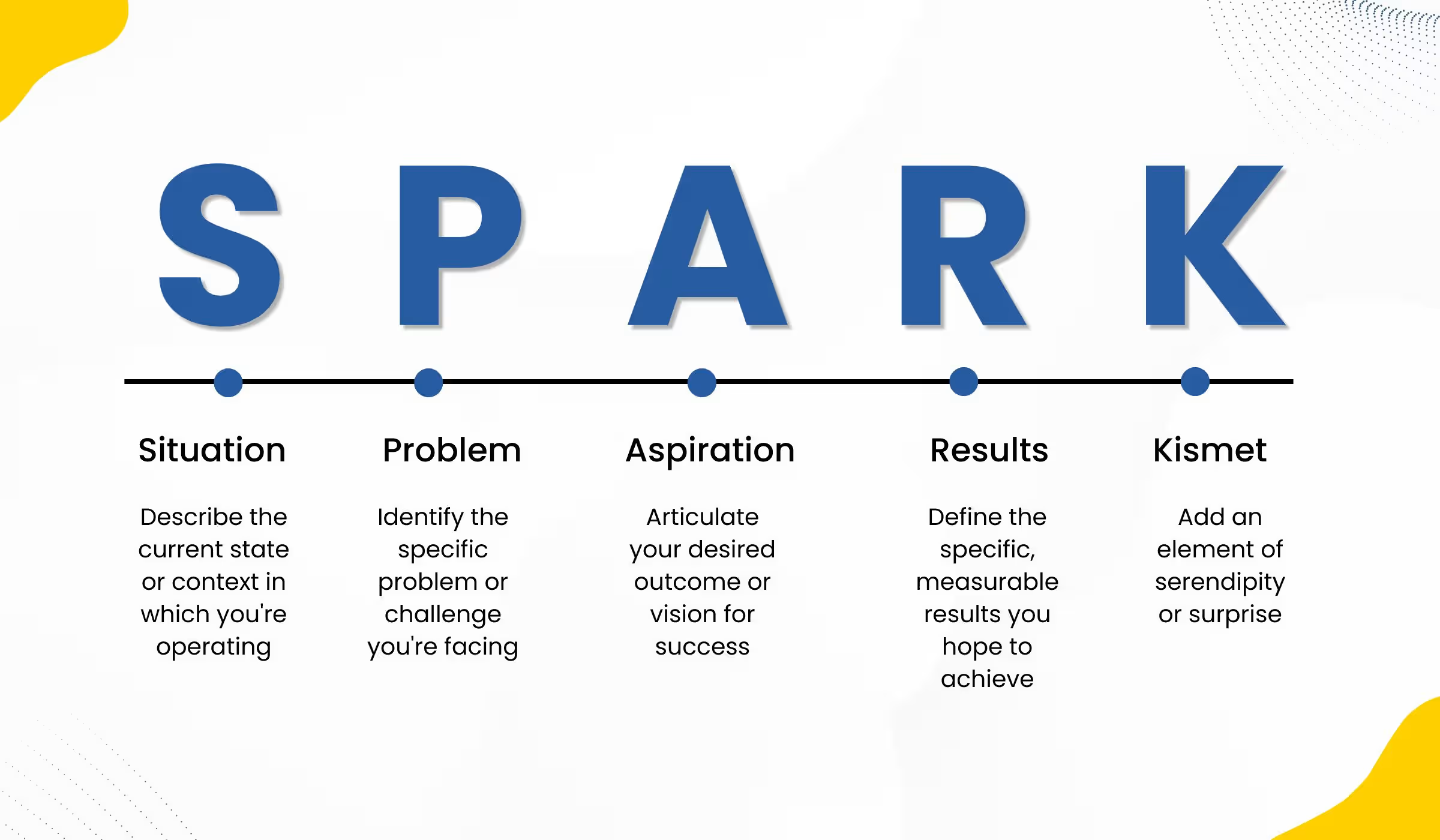
At Idea Fueled, we use a structured framework called SPARK to organize SaaS content marketing by growth stage.
SPARK stands for: Signal, Position, Attract, Retain, Keep Growing.
Each letter maps to a specific growth stage and a specific content objective. Together they form a complete pipeline content system. The framework breaks SaaS growth into three stages: Early, Scaling, and Advanced. Content strategy shifts meaningfully across each stage.
| Letter | Phase | Stage | Content Goal | Key Content Types |
| S | Signal | Early | Build awareness and category trust | SEO blogs, how-to guides, thought leadership essays |
| P | Position | Early | Own a specific problem space | Opinion pieces, niche topic clusters, pillar pages |
| A | Attract | Scaling | Capture high-intent, buying-stage traffic | Comparison pages, use-case content, alternative posts |
| R | Retain | Scaling | Nurture prospects through the funnel | Email sequences, case studies, webinars, demo content |
| K | Keep Growing | Advanced | Convert, expand, and reduce churn | Product-led content, ROI calculators, upsell guides, tutorials |
Stage 1: Signal and Position (Early Stage)
In the early stage, your brand is unknown to the market. Credibility is your most urgent asset. Signal content answers one question: What problem does my ICP search for right now?
You write educational content that speaks directly to your Idea Customer Persona’s (ICP’s) pain. You do not promote the product at this stage. Premature selling destroys trust before it starts.
Position content answers a different question: What specific point of view does our brand hold on this problem? Early-stage teams should build 5 to 8 core topic clusters. Each cluster needs one pillar page and 4 to 6 supporting posts.
- Pillar page example: ‘The Complete Guide to Sales Pipeline Management for B2B SaaS’
- Supporting post: ‘How to Reduce Sales Cycle Length with CRM Automation’
- Bottom-of-funnel post: ‘Best CRM Software for SaaS Sales Teams in 2026’
Counterintuitive insight: bottom-of-funnel keywords convert far better than awareness keywords. They bring fewer visitors. But those visitors are actively buying. Prioritize them from day one.
Stage 2: Attract and Retain (Scaling Stage)
You have organic traffic. You have a growing email list. Now the goal shifts from awareness to qualification. Attract content targets buyers who actively compare solutions. These readers check G2, read comparison posts, and look for proof of results.
Give them exactly that. Build honest comparison content. Acknowledge where competitors are genuinely strong. Then explain clearly why your product wins for your ICP’s specific situation.
Buyers trust honest comparisons far more than self-promotional content. Honesty converts. Retain content nurtures warm leads who are engaged but did not convert yet. Email sequences, targeted webinars, and follow-up case studies do this work.
The key principle: map email sequences to buyer intent, not to your publishing schedule.
Segment A: First-time blog reader. Send 3 educational posts over 10 days.
Segment B: Pricing page visitor. Send a case study and a direct demo invite within 48 hours.
Segment C: Free trial user. Send a 5-email onboarding sequence with product-led how-to content.
Stage 3: Keep Growing (Advanced Stage)
The pipeline is now active and generating qualified leads. The goal shifts to conversion speed and account expansion. Product-led content carries the heaviest load here. It shows your product solving specific real-world problems in exact, reproducible steps.
Prospects who consume product-led content arrive at demos already informed. Sales cycles shorten. Objections get resolved before the call begins.
ROI calculators and interactive assessment tools live in this stage. They let buyers self-qualify and build internal business cases independently.
- Convert free trial users to paying customers through in-app educational content
- Expand existing accounts by building feature adoption and advanced use-case guides
- Reduce churn through customer success content and proactive how-to education
Real Case Study: How HubSpot Built a SaaS Pipeline Machine with Content

HubSpot is the most studied example of pipeline-first content marketing in B2B SaaS. Their approach reshaped the entire marketing industry. They did not just publish blogs on a schedule. They built a full educational ecosystem around one specific buyer: the marketing manager trying to grow inbound leads.
Every single blog post solved a real, specific problem that persona faced on a Tuesday afternoon. No generic industry commentary. No thought leadership for its own sake. Free tools like Website Grader generated millions of qualified email addresses. Each email entered a carefully designed nurture sequence mapped to a specific product.
Templates, certifications, and free courses created massive brand stickiness. Prospects came back repeatedly over months before becoming customers. This outcome was not accidental. HubSpot built their entire content marketing strategy around one core principle: own the problem space, not just the keyword space.
The business result: HubSpot crossed 3 billion dollars in annual revenue with organic content as its primary growth engine.
What Made HubSpot’s Content Strategy Work
- Cluster thinking: They built interconnected topic clusters, not standalone posts. Every piece linked to a larger topic map.
- Bottom-of-funnel investment: They prioritized high-intent conversion content alongside broad awareness content from day one.
- Content as tools: They turned content into interactive tools. Tools generated 10x more leads than static blog posts.
- Pipeline measurement: They tracked demo requests and MQLs from content. Not just traffic.
Consistent publishing: They maintained high-quality output for years. Compounding kicked in after 12 months.
You do not need HubSpot’s budget to apply these exact principles. You need their thinking. Start with one cluster. Build it properly. Measure pipeline. Then scale.
| Idea Fueled Application: Smaller SaaS teams apply this logic at micro scale. Build one topic cluster: one pillar page, four supporting posts, one lead magnet, one five-email nurture sequence. Done properly, that single cluster generates consistent MQLs every month. Then you replicate it across your next most important ICP problem area. |
Content for Traffic vs. Content for Pipeline: The Exact Differences
Most SaaS teams operate in traffic mode while telling stakeholders they are building a pipeline.
The gap between the two modes is real and measurable.
This table shows exactly how traffic-focused content and pipeline-focused content differ at every decision point.
| Decision Point | Traffic-Focused Content | Pipeline-Focused Content |
| Primary Goal | Maximize pageviews and search rankings | Generate demo requests, trial signups, MQLs |
| Starting Point | Keyword research tool | ICP definition and buyer stage mapping |
| Keyword Strategy | High-volume, broad intent terms | Intent-driven, bottom-of-funnel terms specific to ICP |
| Content Depth | Broad coverage of many subtopics | Deep coverage of one ICP-specific problem |
| Target Audience | Anyone searching the category | Your defined ICP only |
| Call to Action | Newsletter signup, social share button | Free trial, demo request, gated case study |
| Follow-Up Path | No mapped follow-up sequence | Triggers a buyer-stage email sequence |
| Success Metric | Monthly sessions, keyword rankings | MQL volume, pipeline revenue attributed to content |
| Review Cadence | Weekly traffic reports | Monthly pipeline contribution review |
You need both modes in your content marketing strategy. Awareness content fills the top of the funnel. Pipeline content converts it.
For early-stage SaaS teams, weight 70% of content toward pipeline intent and 30% toward awareness. Adjust this ratio as your organic audience grows.
What Top Marketers Say About SaaS Content Strategy

| “Content has to do one of two things: bring someone new into your world, or move someone already in your world toward a decision. If your content does neither, it is just noise.” — Rand Fishkin, Founder of SparkToro and Moz |
This insight separates strategic content marketing services from simple content publishing.
Both goals can coexist in a single blog post. A how-to guide builds awareness at the top. A relevant case study CTA at the bottom moves intent forward.
Design this intentionally. Before publishing any piece, ask: who does this bring in, and who does it move forward?
If your content cannot answer either question, it needs revision before it goes live.
The Four Content Types Every SaaS Pipeline Needs
A productive SaaS content marketing calendar runs on four distinct content categories.
Each category plays a specific role in the pipeline. Missing even one creates a gap that buyers fall through.
Here is each type explained in full, with examples and execution details.
1. Problem-Aware Content
This content targets buyers who feel the pain but do not know the solution category yet. They search broad symptom-level terms.
Target search intent: ‘Why does my sales team keep missing follow-up calls?’
Your goal is to name the problem with precision, explain why it happens, and introduce possible solution approaches. Do not sell your product at this stage. Build trust first.
Problem-aware content wins awareness-stage keywords. More importantly, it builds brand familiarity with buyers who will return months later when they are ready to evaluate tools.
- Write in an educational tone, like a helpful colleague solving a problem over coffee
- Include data or original research to support your framing of the problem
- Define the problem space clearly and specifically, not broadly
- End with an internal link to solution-aware content in the same cluster
- Add a light CTA like a newsletter or free resource download, not a demo request
2. Solution-Aware Content
These readers know exactly what type of solution they need. They now compare specific vendors and tools.
Target search intent: ‘Best CRM tools for SaaS startups in 2026’
This is your highest-converting content type. Handle it with extreme care and honesty.
Build comparison tables. Include competitor product names. Be fair and balanced. Acknowledge where competitors are stronger for specific use cases.
Buyers deeply distrust one-sided comparisons. Honest comparisons build the trust that closes the pipeline.
- Build a detailed comparison table covering 6 to 8 features most important to your ICP
- Include verified third-party review ratings from G2, Capterra, or similar platforms
- Place a high-intent CTA directly below the comparison table, not at the bottom of the post
- Address the most common objection to your product directly within the post
- Link to 2 to 3 supporting case studies that match the ICP profile of the reader
3. Product-Led Content
Product-led content shows your software solving a specific real-world problem in precise, repeatable steps.
Example: ‘How to Automate Onboarding Email Sequences Using [Your Product]’
This content serves two audiences simultaneously. Prospects see direct proof of your product’s capability. Existing customers extract more value from the product.
Product-led content also reduces customer support volume significantly. Users who regularly consume how-to content understand the product better. They churn less.
- Include screenshots of the actual product interface at each step
- Write in exact step-by-step format with one action per step only
- Add a FAQ section at the end covering the three most common errors users make
- Link to related documentation, tutorials, and adjacent use-case posts
- Include a CTA to start a free trial directly after the first demonstration of value
4. Trust Content
Case studies, testimonials, and ROI proof close the final cognitive gap between intent and purchase.
B2B SaaS buyers read at least one case study before requesting a demo. Many read two or three.
Weak case studies say: ‘Improved efficiency significantly.’ Strong case studies say: ‘42% reduction in time-to-close within 90 days of implementation.’
Specificity builds credibility. Vague outcomes build skepticism.
- Build case studies organized by ICP vertical: fintech SaaS, HR tech, e-commerce SaaS, etc.
- Use a consistent four-part structure: Challenge, Approach, Result, Customer Quote
- Include a specific, measurable metric in the post title for higher click-through rates
- Gate a premium long-form version to generate MQLs
- Keep a short ungated summary version live for SEO discoverability
SEO, AEO, and GEO: Win Every Discovery Channel in 2026
In 2026, content competes across three separate discovery surfaces at the same time. Optimizing for only one of them leaves a growing share of buyer discovery unaddressed.
- Google Search (SEO): Traditional organic rankings earned through keyword relevance and domain authority.
- AI Answer Engines (AEO): ChatGPT, Perplexity, Google AI Overviews, and Gemini now answer buyer questions directly.
- Generative Engine Optimization (GEO): How AI summarization tools decide which sources to cite and surface in generated answers.
A piece of content that wins Google but gets ignored by AI answer engines misses a growing portion of your buyer’s research journey. Build for all three from the start.
Build a Pipeline, Not Just an Audience
The SaaS companies winning with content marketing today do not publish more than their competitors. They publish more strategically.
They start with the buyer, not the keyword. They build content systems, not content calendars. They track pipeline contributions, not pageviews.
The SPARK Framework provides a structured path from unknown SaaS brand to trusted market authority. Apply each stage with discipline, patience, and a pipeline goal attached.
Early stage: build credibility through Signal and Position content. Scaling stage: capture high-intent buyers and retain them through Attract and Retain content. Advanced stage: convert and expand with Keep Growing content.
Pair every piece of content with a distribution plan. Tie every content investment to a specific pipeline metric. Refresh your best-performing posts on a quarterly schedule.
Content that builds pipeline feels different to read. It answers the exact question a buyer has today. It shows them the next step forward. And it gives them a low-friction path to take it.
That is not just good content marketing. That is the only kind worth building.
If your team needs a content marketing agency that thinks in pipelines, not just posts, Idea Fueled builds strategies that convert.
Frequently Asked Questions
What is the difference between content marketing and content publishing?
Content publishing means putting pieces online consistently. Content marketing means using content strategically to move buyers through a sales pipeline. Marketing requires ICP alignment, intent mapping, and pipeline measurement. Publishing does not.
How long does SaaS content marketing take to generate a qualified pipeline?
Most SaaS teams see meaningful pipeline contribution from organic content after 6 to 12 months of consistent, strategy-led execution. Bottom-of-funnel content and comparison pages generate pipeline faster than awareness content. Expect early signals at month 3 and compounding at month 9 onward.
What content type converts best for the SaaS pipeline?
Solution-aware comparison content and product-led how-to guides consistently convert best for SaaS pipeline. Case studies with specific, named metrics close the final intent gap before demo requests. Pairing comparison content with case studies in the same post produces the strongest conversion rates.
Should a SaaS company hire a content marketing agency or build in-house?
Both approaches produce results when the team deeply understands your ICP. An agency without ICP knowledge produces content that does not convert, regardless of technical quality. An in-house writer without strategy direction faces the same outcome. ICP knowledge and strategic direction are the determining factors, not the employment model.
How do I measure content marketing ROI for a SaaS product?
Track MQL volume from content, demo requests attributed to specific posts, content-assisted closed revenue in your CRM, and trial signups from organic traffic. Ask every new customer in your onboarding survey: ‘Where did you first hear about us?’ First-touch data consistently reveals content’s true pipeline contribution that last-click analytics miss.