

There is a very specific kind of frustration that startup founders know well.
You have traffic. Google Analytics shows green arrows. People are landing on your pages. But the revenue is not coming. Signups are thin. Leads feel random. The funnel looks fine on paper but something, somewhere, is broken.
That feeling has a name: conversion leak. And fixing it is not about spending more on ads. It is not about redesigning your entire website. It is about understanding exactly where your visitors stop trusting you, stop caring, or stop moving forward. Then it is about fixing those exact points, deliberately and methodically.
This blog is about that process. We will go deep on what conversion rate optimization actually looks like for startups, not for enterprise companies with 40-person growth teams, but for lean, scrappy businesses trying to grow with limited resources. We will show you a framework, walk through real tactics, and be honest about what does not work.
If you want a quick-fixes listicle, this is not that. If you want to actually understand your funnel and build something that compounds over time, keep reading.
Let’s Be Honest About the Real Problem
Most startups have a traffic obsession.
They hire for SEO. They run paid ads. They post on LinkedIn and build backlinks and obsess over rankings. None of that is wrong. Traffic matters. But traffic without conversion is just a very expensive vanity metric.
Here is a number that should stop you cold: according to research by Invesp, businesses spend $92 acquiring a customer for every single dollar they spend on conversion optimization.
Ninety-two to one. The money flows entirely toward getting people in the door, while almost nothing goes toward making sure those people actually convert.
Think about what that means for your startup. If you are spending ₹1,00,000 per month on paid acquisition and just ₹1,000 on understanding why people leave, you are building on a leaking foundation. Every rupee you pour into traffic disappears through the holes.
CRO is the work of plugging those holes.
What CRO Actually Means (Beyond the Jargon)
Conversion rate optimization is the systematic process of increasing the percentage of website visitors who take a desired action. That action might be signing up for a free trial, booking a demo call, making a purchase, filling out a contact form, or downloading a resource.
The math is simple:
Conversion Rate = (Number of Conversions / Total Visitors) × 100
If 2,000 people visit your pricing page this month and 60 of them click “Start Free Trial,” your conversion rate is 3%.
Now, according to WordStream’s analysis of thousands of Google Ads accounts, the average landing page conversion rate across all industries is 2.35%. The top 25% of pages convert at
5.31% or higher. And the top 10% of landing pages convert at 11.45% and above.
That gap between 2% and 11% is not luck. It is not brand recognition. It is not even that much about design. It is about a relentless focus on understanding what your visitor needs to feel, know, and believe before they are willing to take action. And then building your pages around that understanding.
The good news for startups: you do not need to be at 11% out of the gate. Moving from 1.5% to 3% on a page that gets 5,000 visitors a month means 75 extra conversions per month. Same traffic budget. Double the output. That is what makes CRO one of the highest-ROI activities a startup can invest in.
Where Startup Funnels Actually Leak
Before we get to solutions, we need to talk honestly about where the leaks happen. And they are usually not where founders expect.
The Homepage Problem
Most startup homepages try to do too much. They explain the product, the team, the values, the pricing, the integrations, and the company story all on one scrolling canvas. The result is a page that says everything and communicates nothing.
A visitor lands on your homepage with one question burning in their mind: “Is this for me?” If they cannot answer that question within five seconds, they leave. Not because your product is bad. Because your page failed to speak to them clearly and fast.
The fix is ruthless clarity. One primary audience. One core problem. One specific promise. One call to action. Everything else is noise.
The Messaging Mismatch
This is the most common and most damaging leak in paid traffic funnels. Someone clicks your Google ad because the ad promised them X. They land on a page that talks about Y. The message does not match. The trust breaks instantly.
We call this the “expectation gap,” and it silently destroys conversion rates across thousands of startup campaigns every day. Your ad copy and your landing page headline should tell the same story, use the same language, and deliver on the same promise. When they do, conversion rates jump significantly, often doubling or tripling overnight.
The Pricing Page Paralysis
Pricing pages carry enormous psychological weight. Visitors arrive already considering buying, which means they are also in full risk-assessment mode. They look for reasons to walk away.
If your pricing page is vague, confusing, or lacks context, it gives them those reasons. If it does not answer questions like “What happens after the free trial?” or “Can I cancel anytime?” or “What plan is right for a team our size?”, visitors will not email you to ask. They will just leave.
The best pricing pages answer objections before visitors can voice them. They show social proof right next to the price. They make the comparison between plans clear and logical. They remove uncertainty.
Form Friction
Forms are where intent converts into action, which makes them high-stakes. And most startup forms ask for way too much.
Every field you add to a form is a micro-decision you are asking the visitor to make. Name, okay. Email, sure. Company size, phone number, job title, industry, annual revenue… and suddenly the form feels like a job application, not a signup page. The visitor closes the tab.
The rule of thumb: only ask for what you absolutely need right now. You can always get more information later, once you have earned the relationship.
The Trust Gap
Trust is the invisible variable that makes or breaks conversions. Visitors who do not trust your brand will not give you their email, their credit card, or their time. And trust is not built through a “100% Secure” badge alone.
Real trust comes from specificity. Specific customer names and results (not vague “happy customers” testimonials). Clear privacy policies that are easy to understand. A product that actually looks like it works. A company that has clearly thought about the buyer’s experience.
Lack of trust is one of the top four reasons shoppers abandon their carts at checkout, according to Matomo’s analysis of conversion research.
If people are reaching your checkout or your CTA and still bailing, trust is almost always part of the problem.
The SEAL Framework: A Practical CRO System Built for Startups
Most CRO advice you find online is written for companies that already have strong traffic and dedicated testing teams. It assumes you have months of A/B test data, conversion analysts on payroll, and pages getting 50,000 visitors a month.
That is not most startups.
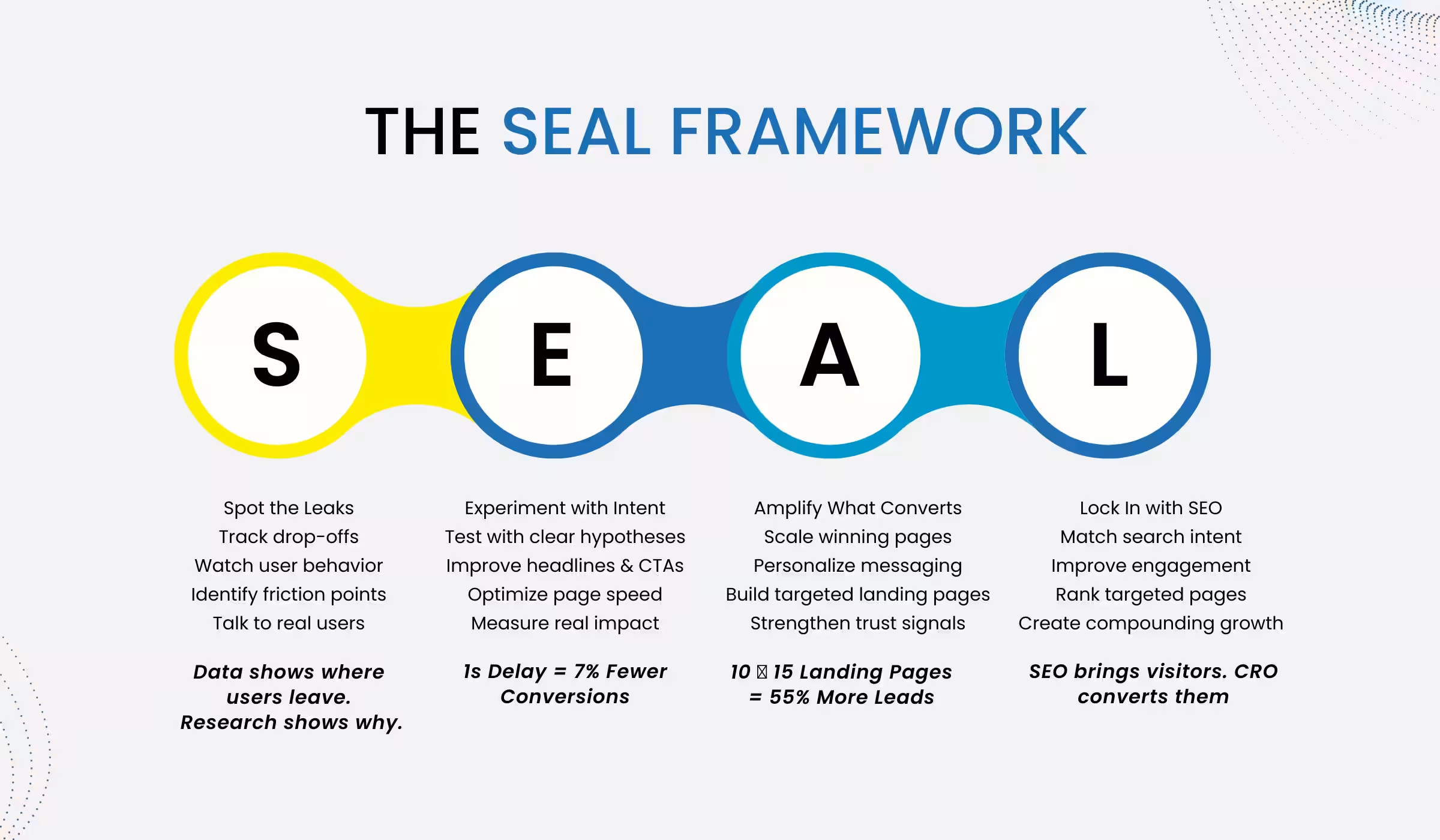
We built the SEAL Framework specifically for lean teams who need a clear, stage-appropriate approach to CRO. It works whether you are pre-revenue or scaling toward Series A.
SEAL stands for:
S – Spot the Leaks
E – Experiment with Intent
A – Amplify What Converts
L – Lock In with SEO
Let us walk through each stage in practical terms.
S: Spot the Leaks
This is the diagnostic phase. You cannot fix what you do not understand, and the biggest CRO mistake startups make is jumping straight to solutions before they have done the detective work.
Spotting leaks means building a clear picture of how visitors move through your funnel, where they slow down, where they stop, and what they were trying to do when they left.
Start with quantitative data. Set up funnel visualization in Google Analytics 4. Look at the step-by-step drop-off between pages. If 1,000 people hit your pricing page and only 40 go to signup, that 96% drop is screaming at you. Find those numbers first.
Then go qualitative. Numbers tell you where people leave. They do not tell you why. For “why,” you need tools like Microsoft Clarity (free) or Hotjar. Watch session recordings. Watch where people scroll, where they stop, what they click that leads nowhere. It is uncomfortable to watch people struggle on your own pages. It is also extraordinarily useful.
Talk to actual humans. Set up 20-minute calls with recent signups and with people who visited but did not convert (if you can reach them). Ask open questions. What were you hoping to find? What nearly stopped you from signing up? What almost made you leave? The language your customers use to describe your product is often better than anything a copywriter could produce, and it reveals the real objections you need to address.
Look at your competitor pages. Not to copy, but to understand the standard your visitors are comparing you to. If every competitor’s pricing page has a FAQ section and yours does not, visitors notice the gap.
This phase should take two to three weeks. It is not glamorous. It does not produce immediate results. But it is the most important work you will do in CRO because it ensures everything you build after is grounded in reality, not assumption.
E: Experiment with Intent
Once you know where the leaks are, you start running experiments to fix them. But the word “experiment” is key. This is not about making changes based on gut feel. It is about forming a hypothesis, testing it against real traffic, and making decisions based on data.
A well-formed hypothesis looks like this:
“We believe that changing the headline on our landing page from [current] to [new] will increase signups because [reason based on research].”
That structure, belief plus expected change plus reason, keeps your testing disciplined. It forces you to think through why a change might work before you implement it.
What to test first. Prioritize based on impact and traffic volume. High-traffic pages with low conversion rates are your biggest opportunity. Within those pages, the elements with the most leverage are typically: the main headline, the primary CTA (both copy and placement), the hero section, and the form.
A one-second delay in page load time reduces conversions by 7%, according to research cited by both Portent and ZoomInfo. Page speed is technical, not glamorous, but it is often the fastest win available. Fix that first.
A word of honest caution about A/B testing. A/B testing is genuinely powerful. It is also genuinely difficult to do well. You need enough traffic to reach statistical significance, which typically means thousands of visitors per variation, not hundreds. Tests need to run long enough to account for weekly behavior patterns, usually two to four weeks minimum. And most tests fail, meaning the challenger does not beat the control. That is normal. Plan for it.
If your pages do not have enough traffic to run reliable A/B tests, lean harder into qualitative research and make bold changes based on what you learn. A/B testing is a tool, not a prerequisite.
A: Amplify What Converts
When you find something that works, your job is to amplify it systematically.
This means taking winning copy patterns and applying them across similar pages. It means expanding your landing page library. It means building more specific pages for more specific audiences, because specificity is what converts.
Here is data that many startups overlook: according to HubSpot’s Marketing Benchmarks Report, based on analysis of 7,000 businesses, companies that go from 10 to 15 landing pages see a 55% increase in leads. Companies with more than 40 landing pages generate over 500% more leads than those with fewer than 10.
Why does this happen? Because each landing page you create is a targeted conversation. Instead of one generic homepage that tries to speak to everyone, you have 15 pages that each speak to a specific person with a specific problem. The message fits. The visitor feels understood. They convert.
Amplification also means doubling down on trust. Addressing buyer fears and objections on landing pages can increase conversion rates by up to 80%, according to research shared by Marcus Sheridan at HubSpot Inbound. Not vague reassurances. Specific, direct answers to the exact fears your visitors carry: “Will this be hard to set up?” “Will I get locked in?” “What if it does not work for me?”
Answer those questions on your pages, near your CTAs, and watch what happens.
L: Lock In with SEO
SEO and CRO are often treated as separate departments with separate goals. They should not be.
Think about it from first principles. SEO brings people to your pages. CRO turns those people into leads and customers. A page that converts well will naturally perform better on engagement metrics, lower bounce rate, longer time on page, more return visits. Google notices all of those signals. Better engagement leads to better rankings. Better rankings bring more qualified traffic.
More qualified traffic converts at higher rates. The loop is self-reinforcing.
This is exactly why investing in SEO services for small businesses alongside CRO creates compounding returns that neither discipline achieves alone.
There is also a structural argument for integrating the two. When you create targeted landing pages for CRO purposes, each page is an opportunity to rank for specific keywords. A landing page built for “project management software for remote teams” serves a CRO purpose by speaking to a specific audience, and an SEO purpose by targeting a specific search query. One piece of work, two growth levers.
The practical integration looks like this: build landing pages that match search intent precisely. Write headlines that reflect the language your target audience uses when they search. Use schema markup so your content appears in rich results and AI-generated answers. Ensure every page loads in under two seconds. Create content that earns links naturally because it is genuinely the most useful resource on the topic.
SEO brings the visitor. CRO converts them. Build both, together, from the start.
The Downside of CRO Nobody Talks About
We promised honesty, so here it is.
CRO is not a fast win. Founders who start an optimization program expecting to see dramatic revenue changes within the first month will almost always be disappointed. Testing takes time.
Data takes time to accumulate. Analysis takes discipline. Implementation takes development resources. And even when you get it right, the gains often look modest in the short term, even when they compound beautifully over 12 months.
There is also a psychological challenge in running tests that fail. You will invest time building a new landing page variation, run it for three weeks, and discover it performs worse than what you had. That is not failure. That is learning. But culturally, many startup teams struggle to maintain enthusiasm for a process that produces a lot of “nothing changed” results.
The teams that win at CRO are the ones who treat it like product development. They run experiments constantly, not episodically. They document what they learn. They build on previous tests. They hold the long view.
If your team cannot commit to that kind of sustained effort, CRO will feel like wasted time. It is not. But it requires a different mindset than most marketing activities.
What Separates Startups That Win at CRO

After working with growth-stage companies across sectors, the pattern is clear. The ones that build real conversion advantages share a few common traits. Here is exactly what they do differently, and what their less successful counterparts do instead.
| Winning Trait | What It Looks Like in Practice | What Losing Startups Do Instead |
| Obsessed with the visitor, not the product | Every page decision starts with: “What does this specific person need to feel right now?” Copy speaks to the buyer’s problem first, the product second. | Pages lead with feature lists, company history, and awards. The visitor never sees themselves in the content. |
| Treat copy as the primary design element | Headlines are tested before colors. Words are rewritten before layouts are changed. The best-converting pages are often visually simple but verbally precise. | Weeks go into visual redesigns while the headline has not changed in two years. Beautiful pages with confused messaging. |
| Measure the right things | They track conversion rate by page, by traffic source, by device type, and by audience segment. Decisions are tied to specific numbers. | They report on total traffic, bounce rate, and page views. None of those metrics tell you whether the funnel is working. |
| Never stop testing | Markets shift. Audiences evolve. What converted in 2023 may not convert today. Their experimentation calendar is always full, never paused. | CRO is treated as a project with a start and end date. Once the redesign launches, testing stops until something breaks. |
| Connect CRO directly to revenue | Every test is tied to pipeline impact and closed deals. The program gets budget and attention because leadership can see the number it moves. | CRO lives as a marketing side project. It gets deprioritized the moment growth pressure hits, which is exactly when it matters most. |
Closing Thought
Conversion rate optimization is not a marketing tactic. It is a philosophy.
It says: we care enough about our visitors to understand what they actually need, not just what we think they need. We respect their time enough to make our pages clear and their decisions easy. We are humble enough to test our assumptions rather than act on them blindly.
The startups that build this mindset early develop an unfair advantage. While competitors keep throwing money at traffic, they keep getting more from the traffic they already have. The gap compounds. The advantage grows.
Your funnel is leaking right now. Every day you wait to fix it is revenue you will not get back.
The good news is that you now know where to look and how to start. At Idea Fueled, we work with startups and small businesses who are tired of watching traffic arrive and leave without converting. We run full funnel audits, build CRO strategies grounded in real data, and integrate SEO so that every optimization compounds over time.
Book a Free Funnel Audit with Us
FAQ’s
What is a good conversion rate for a startup?
There is no universal “good” rate, because it varies significantly by industry, traffic source, and what you are asking visitors to do. According to WordStream’s analysis of thousands of Google Ads accounts, the average landing page conversion rate across all industries is 2.35%. The top 25% convert at 5.31% or above. If you are below 2%, there is meaningful room to improve. If you are above 5%, your focus should shift to scaling traffic while protecting the rate you have built.
How long does CRO take to show results?
Honest answer: longer than most people expect. A single A/B test needs at minimum two to four
weeks to run, and even longer if your page traffic is low. A full CRO program that produces reliable, compounding results typically takes three to six months to build meaningful momentum. The first month is diagnostic. The second and third months are testing. Results start stacking from month four onward when you have enough learnings to amplify.
What should a startup test first?
Start with your highest-traffic page that has the lowest conversion rate. Within that page, test the main headline first. It is the single highest-leverage element on any page. Then test your primary CTA copy and placement. Then your form length. Do not test button colors or font sizes until you have exhausted copy and structure changes. Message changes produce meaningful results. Visual tweaks rarely do.
Is CRO only for e-commerce?
No, and this misconception costs a lot of B2B and SaaS startups real money. CRO applies to any funnel with a desired action: demo bookings, free trial signups, contact form completions, resource downloads, email subscriptions. The principles are the same regardless of industry. Understand what your visitor needs to feel before they act. Remove friction. Build trust. Test relentlessly.
What metrics should a startup track for CRO?
Track conversion rate by page, by traffic source (paid vs. organic vs. direct), by device type (desktop vs. mobile), and drop-off rate at each step of your funnel. These four slices show you exactly where the problems are and which audience segments underperform. Site-wide conversion rate alone is too blunt an instrument to act on.