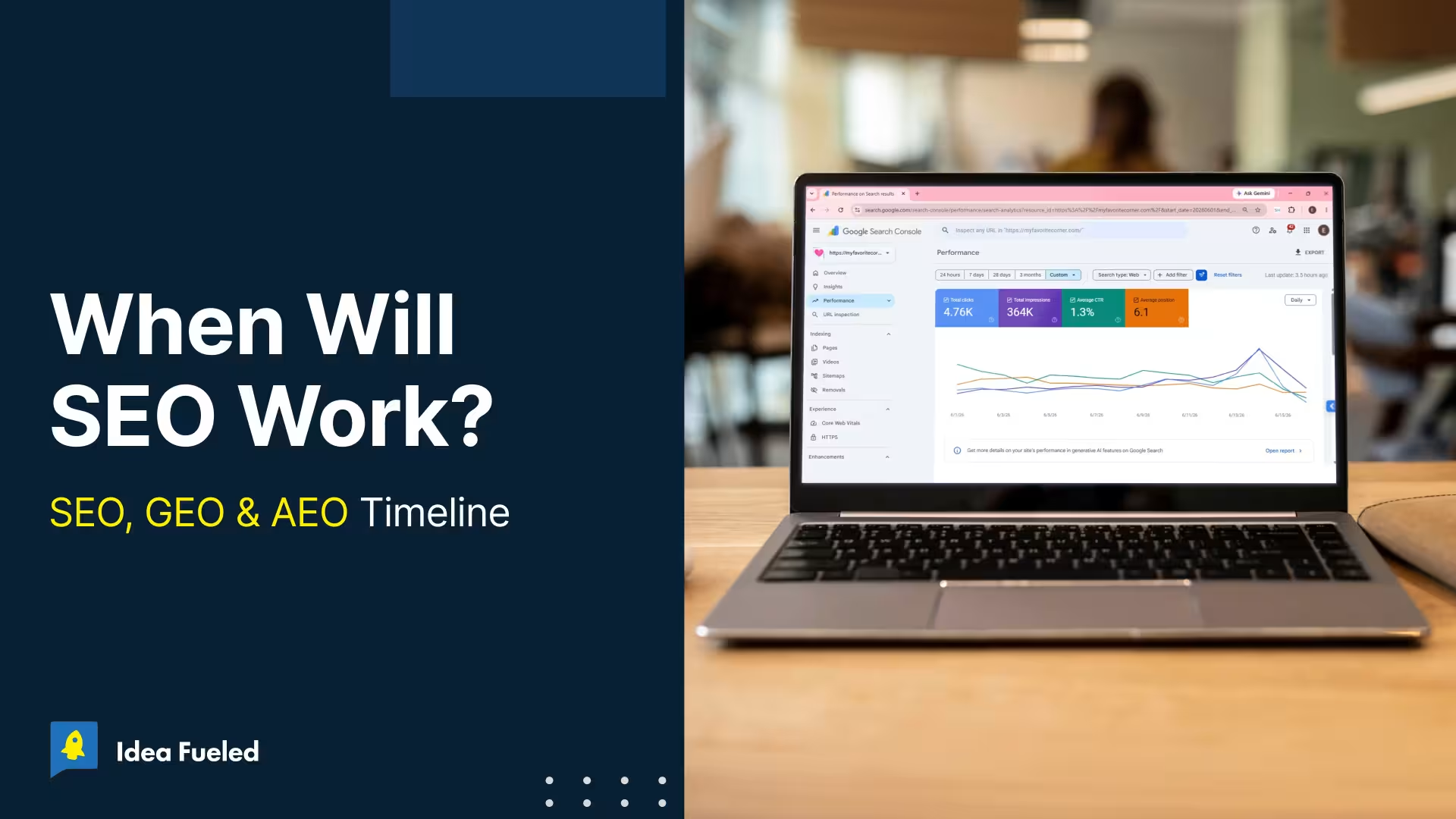


Search is no longer a single lane. Content now needs to rank on Google, get cited by ChatGPT, and surface inside Perplexity, all at the same time. That is exactly what Hybrid Engine Optimization is built for.
You did everything right. You wrote long-form content. You earned backlinks. You chased that coveted Page 1 spot. Then, almost overnight, your traffic started dropping because the search landscape quietly changed beneath you.
Google AI Overviews now answer questions before users ever scroll. ChatGPT fields hundreds of millions of queries every week. Perplexity pulls direct citations and skips the blue links entirely. Traditional SEO still matters, but it no longer works alone.
Enter Hybrid Engine Optimization, the emerging framework that bridges the gap between traditional SEO and the fast-growing world of AI search engine optimization.
What Is Hybrid Engine Optimization (HEO)?
Hybrid Engine Optimization (HEO) is a content and visibility strategy that simultaneously optimizes for traditional search engines like Google and for AI-powered answer engines like ChatGPT, Perplexity, and Google AI Overviews. It treats both as distinct but interdependent discovery channels and builds content that performs well in both environments.
The word “hybrid” does not ask you to abandon SEO. It asks you to extend it. You keep building topical authority, earning backlinks, and structuring content for crawlability. But you layer on the logic of AI citation optimization, structured content, and semantic search. This helps AI models to find, trust, and reference your content.
Think of it this way: SEO gets you in front of algorithms. HEO gets you in front of algorithms and AI models. It doubles your surface area for discovery.
What HEO Is Not?
HEO(Hybrid Engine Optimization) is not a replacement for SEO. It is not a separate content strategy you run in parallel. And it is not just a buzzword for “writing for AI.” It is a unified optimization philosophy that acknowledges a simple truth: your audience now searches in more than one place.
Why the Old SEO Playbook Is Breaking Down?
To understand what HEO is in marketing, you need to understand what changed. The shift is not subtle.
61% Organic click-through rates for informational queries dropped 61% after Google AI Overviews appeared, while paid CTRs on those same queries fell 68%. This data comes from Seer Interactive’s analysis of 25.1 million organic impressions across 42 organizations from June 2024 to September 2025. (Seer Interactive, 2025)
That is not a dip. That is a structural break. And it is happening at the same time that AI-native search tools are growing at speed. Google AI Overviews now reach 1.5 billion monthly users across 200 countries, making it the largest generative AI deployment in the world.
Meanwhile, zero-click search continues to climb. Research published by SparkToro and Similarweb shows that approximately 60% of Google searches in 2025 end without a single click to a website. Users get their answer. They leave. Your content never gets a visit, even if you ranked first.
This is the context in which HEO was born. It is a direct response to a fractured discovery environment.
“The metric of success is no longer ranking position. It is share of voice across every channel where your buyer asks a question, and that now includes AI models.”
~ Rand Fishkin, Co-founder of SparkToro & Moz, on the future of search measurement
HEO vs. SEO vs. GEO: The Clear Difference
Before diving into how HEO works, it helps to understand how it differs from the two disciplines it synthesizes: traditional SEO and Generative Engine Optimization (GEO)
| Factor | Traditional SEO | GEO | HEO (Hybrid) |
| Primary Target | Google, Bing search index | AI answer engines (ChatGPT, Perplexity) | Both simultaneously |
| Success Metric | Ranking position, organic traffic | AI citation frequency, share of voice | Visibility across all discovery channels |
| Content Structure | Keyword density, headers, backlinks | Conversational, answer-first, cited sources | Both, layered on a single content asset |
| E-E-A-T Signals | Important for Google ranking | Critical for AI model trust | Central to the entire strategy |
| Schema / Structured Data | Optional but helpful | Essential for machine readability | Required at every content layer |
| Zero-Click Resilience | Low, traffic drops when CTR drops | Medium, citation visibility remains | High, brand surfaces even without clicks |
| Lifespan of Strategy | Declining as AI search grows | Growing but still niche | Built for the long term |
The key insight in this table: HEO does not ask you to choose a lane. It treats every lane as connected. A piece of content optimized through an HEO lens can rank on Google, appear in an AI Overview, get cited by Perplexity, and earn a mention inside a ChatGPT response, all from the same underlying asset.
What are the Key Benefits of Hybrid Engine Optimization?
Understanding the benefits of HEO matters before you build the strategy. These are not theoretical advantages. Each one addresses a real and measurable problem that traditional SEO can no longer solve on its own.
1. You Get Visibility Even When No One Clicks
With zero-click search at roughly 60% of all Google queries, traffic is no longer the only signal of visibility. HEO shifts your success metric to brand presence. When AI models cite you inside a Google AI Overview, a Perplexity answer, or a ChatGPT response, your brand surfaces at the point of decision. No click required.
That is a genuinely new form of reach. And it compounds over time as AI models learn which sources they trust.
2. You Build Authority That Works Across Every Channel
E-E-A-T signals you build for Google, named authors, primary research, expert credentials, all are the same signals that earn AI citations. HEO lets you do one thing well and get credit in two places. That is an efficiency no single-channel strategy can match.
3. You Reduce Dependence on Any Single Algorithm
Google’s core updates have disrupted entire content businesses overnight. Brands that depend on a single platform carry enormous risk. HEO distributes your visibility across traditional search, answer engines, and AI-powered discovery. A Google update that hurts your rankings does not erase your AI citation presence.
This is portfolio thinking applied to content. Diversified visibility is more resilient than concentrated rankings.
4. You Earn the High-Intent Traffic That Still Clicks
Not all clicks are equal. Users who click through after reading an AI-generated summary already understand your topic. They arrive with higher intent and lower bounce rates. HEO targets both the no-click visibility layer and the high-intent click layer simultaneously.
5. You Future-Proof Against the Direction Search Is Moving
Generative search is not a phase. Google’s AI Mode is becoming its primary interface. ChatGPT and Perplexity are expanding their user bases every quarter. The content teams and agencies that build AI search engine optimization strategies today will hold structural advantages when the rest of the industry catches up.
HEO is not reactive. It is a forward position.
6. You Make Content That Humans Actually Want to Read
Here is the benefit that gets overlooked: every HEO best practice, answer-first writing, clear structure, cited evidence, genuine expertise, makes content better for real readers too. There is no tension between optimizing for AI and writing well for people. HEO resolves that false conflict by design.
How HEO Works: The SEARCH Framework

Every effective strategy needs a repeatable system. For hybrid engine optimization, we use the SEARCH Framework, a six-stage model for building content that performs across both traditional and AI-driven discovery channels.
Each letter represents one layer of optimization. Apply all six, and your content becomes citation-worthy in both traditional and generative search environments.
S = Structure: Build for Machines First, Readers Always
Machine-readable content is the foundation of HEO. AI models do not browse your site the way a human does. They parse markup. They read semantic hierarchy. They extract entities.
Every HEO-optimized piece uses proper H1/H2/H3 nesting, FAQ schema markup, and structured definitions that an AI model can extract verbatim. If your content is a wall of prose with no structural logic, even great writing will get ignored by generative search models.
E = E-E-A-T: The Trust Signal That Crosses Both Worlds
E-E-A-T (Experience, Expertise, Authoritativeness, Trustworthiness) matters to Google. But it matters equally, if not more, to AI models. When Perplexity or ChatGPT cites a source, it pulls from content that signals genuine expertise and real-world experience.
HEO requires you to make E-E-A-T visible at the content level. Name your authors. Add credentials. Link to primary research. Ground every claim in evidence. Do not just tell AI models you are an expert, show them.
A = Answer-First: Win the Zero-Click and the Citation
The zero-click search era rewards one writing behavior above all others: answering the question in the first sentence.
When you write answer-first, you achieve two things simultaneously. You increase your chances of being pulled into a Google AI Overview. And you give AI models a clean, extractable answer they can cite. This is the overlap where HEO creates the most leverage.
R = Relevance: Speak the Language of Semantic Search
Modern search engines, both traditional and AI-powered, operate on semantic search logic. They look for topical completeness, not just keyword matches. They understand entities, relationships, and context.
HEO-optimized content covers a topic with depth. It addresses related questions. It uses natural language variations. It names relevant entities people, organizations, tools, locations, that signal topical authority to both Google and AI models.
C = Citation: Build the Web That AI Models Follow
This is where HEO diverges most clearly from old-school SEO. Traditional SEO chases backlinks. HEO chases citations in the right places.
35% Websites cited within Google AI Overviews earn 35% more organic clicks and 91% more paid clicks compared to sites not cited. Being in the citation layer is now more valuable than ranking first in the blue links. (Seer Interactive, 2025)
To earn citations, you need content that other credible sources want to reference. That means publishing original data, useful frameworks, clear definitions, and expert perspectives that AI models see as reliable, extractable, and repeatable.
H = Humans: The Signal That Never Becomes Obsolete
Every algorithm update, from Google Panda to AI Mode, has moved in one direction: toward genuine human value. HEO keeps humans at the center. Write for real people with real questions. Make the content useful, honest, and clear.
AI models are trained on human judgment. When content satisfies real people, it eventually satisfies the models that learn from them.
The Channels HEO Targets And Why Each of Them are Important?
1. Google Traditional Search
Google still processes billions of queries daily. It remains the dominant search channel by volume. HEO does not walk away from it. It builds keyword relevance, domain authority, and technical SEO as the bedrock layer.
2. Google AI Overviews
Google AI Overviews now appear in over 13% of all U.S. desktop searches, more than double the rate seen in January 2025, according to Semrush’s analysis. They sit above organic results, pull structured answers, and give enormous visibility to cited sources — even when clicks never happen.
AI discoverability through Overviews has become a brand-building channel in its own right. You may never get the click. But your brand name appears at the top of the page, attributed as a credible source.
3. ChatGPT and Perplexity
These are the true answer engines. ChatGPT now has over 900 million weekly active users. Perplexity handles roughly 780 million queries per month. Both pull from public content, prioritize cited sources, and surface answers in ways that bypass the traditional SERP entirely.
Optimizing content for AI search on these platforms requires a different mindset: concise definitions, credible references, entity clarity, and content that reads like a reliable source rather than a promotional asset.
4. Voice and Multimodal Search
HEO also looks ahead. Voice-based queries reward conversational, question-answer formatted content. Multimodal search such as combining text, images, and real-time data, is expanding very fast. Content built with semantic depth and structured clarity performs well as these channels grow.
8 Ways To Optimize Content for Both Google and AI Search
The practical execution of HEO comes down to a set of concrete content decisions. These are not abstract principles, they are choices you make at the keyboard.
1. Open with a direct definition. The first paragraph should answer the primary question completely. No throat-clearing, no scene-setting.
2. Use FAQ sections with schema markup. AI models love question-answer pairs. Google surfaces them in featured snippets. They work in both worlds.
3. Cite primary research, not aggregators. Link to the original study, not the “Top 30 Stats” roundup. AI models trace provenance.
4. Name entities explicitly. Mention specific tools, platforms, researchers, and organizations. Entity-based SEO is how semantic engines build topical maps.
5. Write at a natural reading level. Short sentences. Active voice. Clear structure. This is not just good writing, it is what AI extractors prefer.
6. Publish consistent topical depth. One great article is not enough. AI models recognize authority through content clusters, not individual pieces.
7. Add author credentials and real attribution. Every E-E-A-T signal you add increases the probability of AI citation.
8. Use structured data markup. Article schema, FAQ schema, How-To schema, these make your content machine-readable at the source code level.
Approximately 60% of all Google searches in 2025 end without a click to any website — a phenomenon researchers call the zero-click search crisis. Brands that get cited in AI responses maintain visibility even inside this click-less environment. (The Digital Bloom, 2025)
The Future of SEO and AI Search
Here is the hard truth about the future of SEO and AI search: the platforms are not going back. Generative search is the default experience for a growing share of users worldwide. The question is not whether to adapt, it is how fast.
AI search engine optimization strategies will keep evolving as models improve. But the underlying logic of HEO is durable. Trustworthy content, structured clearly, published by credible sources, covering topics with genuine depth, that is what has always worked. HEO simply extends that logic into a multi-channel future.
The brands that win the next five years of search will not be the ones that optimized best for 2019. They will be the ones that built real authority, the kind that both humans and AI models recognize as worth citing.
$18.5B: The global AI search engine market was valued at $18.5 billion in 2025 and is forecast to reach $66.2 billion by 2035, growing at a 14% CAGR. The optimization strategies brands build today are positioning for a channel that is still in its early innings. (Future Market Insights, 2025)
What HEO Looks Like in the Next 2 Years?
AI Mode is becoming Google’s primary interface in the U.S. Perplexity is expanding its enterprise footprint. OpenAI is building its own browser. The shift toward AI discoverability as a core marketing metric is accelerating, not slowing.
HEO is not a trend. It is the operational response to a permanent change in how people find information. The marketers and content teams that build HEO-compliant systems today will own the citation layer when AI search matures.
A Quick HEO (Hybrid Engine Optimization) Audit Checklist
Use this to evaluate whether your current content is HEO-ready:
- Does your article open with a direct, quotable definition or answer?
- Do you use FAQ schema and How-To schema where relevant?
- Does every factual claim link to an original, authoritative source?
- Is your author named, credentialed, and linked to an author page?
- Do you cover the full semantic field of your topic, related entities, tools, and questions?
- Is your content organized into scannable sections that an AI model can extract independently?
- Do you track citations in ChatGPT, Perplexity, and Google AI Overviews, not just rankings?
- Does your content cluster cover a topic deeply enough to signal topical authority?
Tools to Help You Execute HEO Effectively
Strategy without execution is just theory. These tools cover every layer of the SEARCH Framework, from semantic search analysis to AI citation tracking. They are grouped by the job they do inside an HEO workflow, not by price or popularity.
Note: Tool recommendations here reflect documented capabilities and active use by SEO and content professionals as of 2026. No sponsorship or affiliate relationship influences these recommendations.
For Keyword Research and Semantic Coverage
| Ahrefs | HEO use: Maps topical authority gaps, identifies which keywords trigger AI Overviews, and tracks competitor content clusters. Use it to build the semantic content map before writing. |
| Semrush | HEO use: Monitors AI Overview prevalence across your keyword set, surfaces search intent signals, and tracks organic visibility shifts. Semrush’s AI Overview tracking is among the most granular available. |
| Surfer SEO | HEO use: Scores content for NLP coverage and entity-based SEO signals. It identifies which related entities and terms your content needs to cover for topical completeness. |
For AI Citation Monitoring
| Profound | HEO use: Tracks your brand’s citation frequency across ChatGPT, Perplexity, Gemini, and Google AI Overviews. This is the most direct way to measure AI citation optimization performance. |
| Otterly.ai | HEO use: Monitors your brand and competitor mentions inside AI-generated answers. Surfaces which content pieces earn the most citations and why. |
| BrandMentions | HEO use: Tracks brand mentions across the open web, including emerging AI-aggregated content surfaces. Useful for monitoring E-E-A-T signal distribution across the broader web. |
For Structured Content and Schema
| Schema.org | HEO use: The source of truth for structured data markup. Use Article, FAQPage, HowTo, and Person schemas to make your content machine-readable at the code level. |
| Google Rich Results Test | HEO use: Validates your schema markup before publishing. Confirms that Google, and by extension, its AI systems, can correctly parse your structured data. |
| Yoast SEO (WordPress) | HEO use: Automates schema generation for articles, authors, and FAQs. The author and organization schema it generates directly supports E-E-A-T visibility for AI models. |
For Content Quality and E-E-A-T Signals
| Clearscope | HEO use: Grades content for topical depth using NLP analysis. Identifies which related terms and entities your content needs to signal genuine expertise to both Google and AI models. |
| Google Search Console | HEO use: Tracks impressions, CTR, and position data across your content. In the HEO era, watch for the pattern of rising impressions with falling CTR, the signature of AI Overview impact on your pages. |
Common Mistakes to Avoid in Hybrid Engine Optimization
Most content teams approach HEO with the right intention but stumble on execution. These mistakes are not obvious. They look like good SEO practice from the outside, but they actively undermine your AI discoverability and citation potential.
Mistake 1: Optimizing for Rankings Instead of Trust
Getting to position one does not guarantee an AI citation. AI models pull from sources they judge as credible, not just sources that rank high. Teams that chase ranking position without building genuine E-E-A-T signals find their content ignored by AI systems even when it ranks well in traditional search.
The fix: Make authorship, credentials, and sourcing visible in every piece. Trust is a content-level signal, not just a domain-level one.
Mistake 2: Writing for Keywords Instead of Questions
AI-powered answer engines respond to questions. They match conversational queries to content that answers them directly. Content written purely for keyword density, without addressing the natural language form of the question, does not perform well in generative search.
The fix: Map every content piece to the exact question it answers. Then answer that question in the opening paragraph, completely and clearly.
Mistake 3: Treating Schema as Optional
Many content teams skip structured data markup because it feels technical. That is a significant mistake in an HEO context. Machine-readable content with proper schema signals directly influence how AI models parse, extract, and cite your information.
The fix: Implement FAQ schema, Article schema, and Author schema as a publishing standard, not an afterthought. These three alone cover most of the structured data needs for an HEO-optimized content library.
Mistake 4: Publishing Thin Content Clusters
A single well-optimized article is not enough for AI citation. AI models recognize topical authority through coverage depth, the breadth and interconnectedness of your content on a subject. One pillar page surrounded by thin supporting content signals partial expertise at best.
The fix: Build genuine content clusters. Each cluster should cover the full search intent landscape of a topic, definitions, comparisons, how-tos, case studies, and FAQs. Depth and coherence together signal authority.
Mistake 5: Measuring Only Traffic and Rankings
In the zero-click search era, traffic is an incomplete metric. A page can get cited in thousands of AI-generated answers, building genuine brand authority, and generate almost no direct traffic. Teams that measure only clicks will misread their actual performance.
The fix: Add AI citation frequency and brand share of voice to your measurement framework alongside traffic and rankings. Tools like Profound and Otterly.ai make this trackable. What gets measured gets managed.
Mistake 6: Ignoring the Cited-Source Advantage
Most brands know that AI Overviews reduce CTR. Fewer brands act on the flip side: being cited in an AI Overview delivers 35% more organic clicks than not being cited, per Seer Interactive’s research. The citation layer is not just a visibility play, it is a traffic play too.
The fix: Actively audit which of your competitors get cited in AI responses for your target queries. Reverse-engineer their content structure, sourcing habits, and E-E-A-T signals. Then build toward that standard deliberately.
Mistake 7: Skipping the Answer-First Format
Burying the key definition or answer three paragraphs into an article is a habit carried over from legacy SEO. AI models extract answers from the top of content. If your first paragraph is a preamble or a story hook, you lose the extraction opportunity entirely.
The fix: Every piece of HEO content should open with a direct, complete answer to its primary question. Context and nuance follow. The answer comes first, always.
| Ready to Build an HEO Content Strategy?At Idea Fueled, we help brands optimize for the full discovery landscape, from Google rankings to AI citations. If your content strategy has not evolved for the AI search era, now is the time to start. |
Frequently Asked Questions About HEO
1. What is Hybrid Engine Optimization in simple terms?
Hybrid Engine Optimization (HEO) is a content strategy that optimizes for both traditional search engines like Google and AI-powered answer engines like ChatGPT and Perplexity. It treats both as connected discovery channels and builds content that performs well in each one.
2. What is the difference between HEO and SEO?
Traditional SEO focuses on ranking in Google’s blue-link results through keywords, backlinks, and technical optimization. HEO extends that foundation to also optimize for AI citation, semantic search, structured content, and visibility inside AI-generated answers. SEO is a subset of HEO.
3. What is HEO in marketing?
In marketing, HEO is an approach to content and visibility that ensures your brand appears wherever your audience searches, including AI tools. It shifts the success metric from traffic and rankings to share of voice and citation frequency across all search channels.
4. How do I optimize content for ChatGPT and Google AI?
Write answer-first content with direct definitions. Use FAQ sections with schema markup. Cite primary research from credible sources. Name relevant entities clearly. Publish content clusters that signal deep topical authority. These practices make your content extractable and citable by both Google AI and ChatGPT.
5. Is traditional SEO dead?
No. Traditional SEO remains essential because Google still processes the majority of the world’s searches. But SEO alone is insufficient in a world where 60% of searches end without a click and AI models field growing query volume. HEO extends SEO rather than replacing it.
6. What is AI discoverability?
AI discoverability refers to how easily AI models can find, extract, and cite your content when responding to user queries. High AI discoverability means your brand appears inside AI-generated answers, even when users do not click through to your website.
7. How does HEO relate to GEO (Generative Engine Optimization)?
GEO focuses specifically on optimizing for AI answer engines. HEO is broader, it integrates GEO practices with traditional SEO into a unified strategy. GEO is one of the two pillars that HEO is built on.