


Search has changed in a way most marketers are still catching up to.
When someone types a question into Google, ChatGPT, Perplexity, or Gemini today, they often get a fully formed answer, not a list of blue links. A large language model reads, synthesizes, and delivers a response. Your content either gets cited in that answer, or it gets skipped entirely.
That shift has given rise to a new discipline: Generative Engine Optimization, or GEO. It is the practice of structuring, positioning, and authoring content so that AI-powered search engines choose it as a trusted source when building their responses.
This guide breaks down what GEO actually is, how it works, how it compares to traditional SEO, and what a practical GEO content strategy looks like for 2026.
What Is GEO (Generative Engine Optimization)?
Generative engine optimization (GEO) is the process of optimizing content so it gets retrieved, understood, and cited by AI-driven answer engines like ChatGPT, Google AI Overviews, Perplexity, and Bing Copilot, etc.
In simple words: GEO is about making your content the answer AI gives.

Where traditional SEO tries to rank a URL on a search results page, GEO tries to make your content the source an AI model pulls from when synthesizing a response. The distinction matters because AI search engines do not send users ten links. They generate one consolidated answer, and they credit a handful of sources for it.
A 2024 study by researchers at Princeton, Georgia Tech, and IIT Delhi found that specific content signals significantly increase citation frequency in AI-generated answers. These signals include citing statistics, quoting recognized experts, using well-structured prose, and organizing information around clear questions and answers.
GEO is not a replacement for SEO. It is a parallel discipline that operates on the same content but optimizes for a different outcome: selection by an AI model rather than ranking by a traditional algorithm.
How Generative AI Search Engines Actually Work?

Most AI search engines use a process called Retrieval-Augmented Generation (RAG). Here is what that means in practice:
1. A user submits a query.
2. The AI retrieves a set of relevant documents from its index or from a live web crawl.
3. The model reads those documents and synthesizes a coherent response.
4. It attributes parts of the response to specific sources.
The key insight is that the AI is not ranking your page. It is reading it, like a researcher, evaluating whether it is credible, clear, and relevant enough to cite. This means GEO requires a fundamentally different optimization mindset.
You are not optimizing for a crawler scoring keyword density. You are writing for a system that evaluates meaning, content credibility, and usefulness at a language level. Understanding how generative AI affects SEO starts here: the signals that help a crawler rank a page are not the same signals that help an AI decide to cite it.
GEO vs SEO: Same Content, Different Execution
The first question most content professionals ask is: does GEO replace SEO? The answer is NO. The longer answer is that GEO vs SEO is less a competition and more a layered evolution of the same discipline.
| Factor | SEO | GEO |
| Goal | Rank on SERPs | Get cited in AI-generated answers |
| Optimized for | Crawlers and ranking algorithms | Language models and RAG systems |
| Success signal | Page 1 ranking, organic traffic | AI citation frequency, brand mentions in answers |
| Content format | Keyword-rich, structured for scanners | Clear, credible, entity-rich, answer-first |
| Credibility signals | Backlinks, domain authority, on-page optimization | E-E-A-T, sourced data, expert authorship, entity clarity |
The most important overlap between GEO vs SEO is E-E-A-T signals. Google’s experience, expertise, authoritativeness, and trustworthiness framework was always about credibility. AI models apply similar logic when deciding which sources to trust. A site with strong E-E-A-T is also a stronger GEO candidate.
Brands that treat GEO and SEO as competing priorities will underperform. Brands that integrate them will dominate both traditional SERPs and AI search engines.
Why Does Zero-Click Search Make GEO Non-Negotiable?
Before understanding why, you must understand: What is zero-click search? Zero-click search is when you search something and get the answer immediately without clicking any website.
For example:
When Google AI Overview shows up on the SERP, it gives a full summarized answer right at the top. Or, when you search “2+2” → Google shows 4 instantly → you don’t click anything.
Now, Why Zero-Click Search Makes GEO Non-Negotiable? Because Zero click search optimization is the default state of search for informational queries.
SparkToro and Datos published research in 2024 showing that less than 40% of Google searches result in a click. AI Overviews, featured snippets, and knowledge panels now answer queries directly inside the SERP. For informational content, organic traffic has declined across most categories as a direct result.
Generative AI has accelerated this shift. When ChatGPT answers a question, no click happens at all. When Google AI Overviews summarizes a topic, most users read the answer and move on. The traditional model where content creates traffic creates leads creates revenue is breaking down for top-of-funnel queries.
GEO reframes the strategic question entirely. Instead of asking: how do I get traffic from this query? The question becomes: how do I get my brand named in the answer to this query?
Being cited in an AI-generated response builds brand authority even without a click. If your company is named as the source every time someone asks a question in your niche, that is a compounding topical authority signal across thousands of interactions. Over time, brand recall, direct search volume, and inbound leads all reflect that presence.
The 6 Signals AI Search Engines Use to Select and Cite Sources
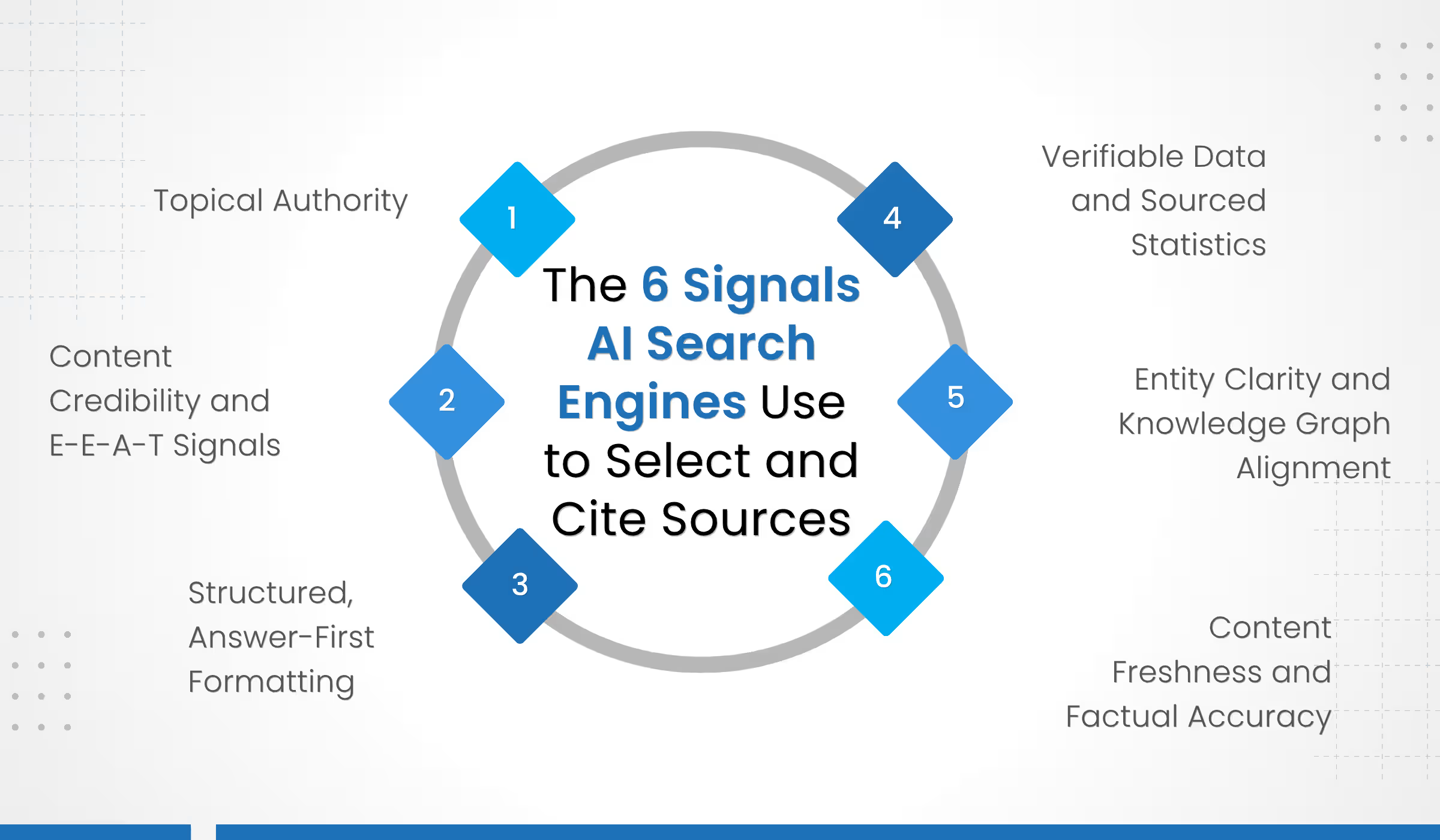
Understanding how AI chooses sources for answers is critical to any effective generative AI search optimization strategy. Based on current research and observed behavior across platforms, these are the six signals that matter most:
1. Topical Authority
AI models assess if your site consistently covers a subject area in detail or not. A single well-written post is not enough. A cluster of interconnected posts covering a topic from multiple angles signals that your site is a credible, authoritative source on that subject. This is entity-based SEO applied directly to GEO.
2. Content Credibility and E-E-A-T Signals
Author bylines with relevant credentials, first-person insights backed by real experience, citations to primary sources, and content that reflects genuine domain expertise all contribute to content credibility. AI systems are increasingly trained to reward content that demonstrates who wrote it and why they are qualified.
3. Structured, Answer-First Formatting
Content that opens each section with a direct, concise answer before expanding performs better in generative retrieval. AI models are question-answering machines. Structured content with clear H2s and H3s that mirror natural language queries, and opening sentences that answer directly, makes extraction easier and citation more likely.
4. Verifiable Data and Sourced Statistics
The Princeton-led GEO research found that adding statistics increased citation likelihood by up to 40% in their test set. AI models prefer content that references external, verifiable sources because it signals factual reliability. Every data point in a GEO-optimized post should link to a primary source.
5. Entity Clarity and Knowledge Graph Alignment
AI models navigate the web through entities, not just keywords. Your brand, your authors, your key topics, and your products should all be clearly named and consistently referenced across your site and across the web. Strong knowledge graphs presence, consistent NAP data, Wikipedia mentions, and authoritative external references all strengthen your entity footprint.
6. Content Freshness and Factual Accuracy
AI search engines using live retrieval weight freshness for time-sensitive queries. Content that is factually accurate, kept current with updated data, and consistent with the model’s training knowledge is more likely to be selected. Outdated statistics or contradicted claims actively reduce citation probability.
GEO Content Framework & Strategy: How to Write for AI Answers in 2026
A practical GEO content strategy is built around four principles: clarity, credibility, coverage, and consistency. Here is how each one translates into execution.
1. Structure Every Post Around an Explicit Question
Use H2s and H3s that match natural language queries exactly. Open every section with a one or two sentence direct answer before expanding. This is the single most actionable change most content teams can make to optimize content for AI search.
2. Build Topical Clusters, Not Isolated Posts
A single optimized post does not build topical authority. A cluster of ten interconnected posts on a subject, each answering a different angle of the same topic, signals complete domain ownership to both Google and AI retrieval systems. Internal linking between cluster posts also reinforces entity relationships.
3. Lead With Data, Close With Expertise
Every section that makes a claim should include a sourced statistic or a referenced case study. Every post should include an author bio with specific credentials. These two elements, verifiable data and demonstrated expertise, are the core E-E-A-T signals that separate citable content from generic content.
4. Use FAQ Schema and Structured Markup
FAQ schema, HowTo schema, and Article schema all help AI systems extract answers directly from your page. Clear heading hierarchies, short paragraphs, and well-labeled definitions make it easier for a language model to parse and cite your content accurately.
5. Write for Humans First, Structure for Machines Second
The best GEO content reads naturally. AI models are trained on human language and reward writing that is clear, coherent, and genuinely useful. Over-engineered keyword placement and mechanical structure actively reduce content quality in AI evaluation. Write to answer the question well. Then audit the structure.
GEO vs AEO: Is There a Difference?
What is the difference between generative engine optimization (GEO) and answer engine optimization (AEO)?
Answer Engine Optimization (AEO) means optimizing content so it shows up as direct answers like featured snippets, answer boxes, and voice search results. It came before AI search and mainly focused on getting content into Google’s quick answer sections (position zero).
Generative Engine Optimization (GEO) means optimizing content so it gets used in AI-generated answers across platforms like ChatGPT, Perplexity AI, Google Gemini, or Google AI Overviews.
| Dimension | AEO | GEO |
| Target | Featured snippets, voice, Knowledge Graph | AI-generated answers across all platforms |
| Platform scope | Primarily Google | Google, ChatGPT, Perplexity, Gemini, Bing |
| Era | Pre-generative AI (2017 to 2022) | Generative AI era (2023 onward) |
| Primary method | Structured data, concise Q&A formatting | RAG-aware content, entity clarity, E-E-A-T depth |
In practice, AEO is a subset of GEO. A strong AEO foundation makes GEO implementation significantly easier. If your content already wins featured snippets, it is already structured in a way that AI models find easy to retrieve and cite.
Core Principles of GEO
These are the non-negotiable principles that underpin every effective GEO strategy, regardless of industry or platform.
- Be clear, not clever: Simple answers get picked by AI and fancy words are avoided.
- Be credible, not lengthy: Quality and proof matter more than word count.
- Stay consistent with your brand: Same name, same identity, everywhere.
- Show real expertise: Original insights beat generic AI-style content.
- Think beyond one platform: Optimize for all AI tools, not just Google.
Why SEO Alone Is Not Enough in 2026?
Traditional SEO is not dead. But it is not sufficient as the only strategy.
Here is the reality of why SEO is changing in 2026: the search behaviors of the people you are trying to reach have fundamentally shifted. A growing percentage of informational queries never reach a traditional SERP at all. They are answered inside an AI interface before a browser opens.
ChatGPT now handles over 900 million queries daily. Google AI Overviews appear in a significant and growing share of searches. Perplexity crossed 30 million daily active users and is growing rapidly among research-intent audiences. Not just that, Anthropic Claude saw 176.12 Million Visitors Each Month. These are not marginal channels. They are primary.
Brands that built topical authority and strong E-E-A-T signals over the past three years are already seeing GEO benefits because those signals transfer directly. Brands that focused narrowly on keyword density and backlink volume are finding their content bypassed in AI retrieval even when they rank well on traditional SERPs.
The content that wins in 2026 is the content that satisfies both audiences: the human reader and the AI model evaluating whether to cite it. That is the most honest quality bar.
How to Start Your GEO Strategy Today?
You do not need to rebuild your entire content library to start gaining GEO traction. Here is a practical, beginner-friendly entry point for a GEO strategy for beginners.
Step 1: Audit Your Top Informational Posts
Identify your ten highest-performing informational posts. For each one, ask three questions: Does this post answer a specific question directly in the first two paragraphs? Does it include at least one verifiable statistic linked to a primary source? Is the author identified with credentials relevant to the topic?
Every no is a GEO optimization opportunity.
Step 2: Add Direct Answer Openings
Rewrite the opening paragraph of each post to answer the core query in two to three sentences. This is the single highest-return GEO edit available, and it takes less than thirty minutes per post.
Step 3: Build or Strengthen Your Topical Cluster
Map the related questions your target audience asks around each core topic. Build or commission posts that answer each one. Link them together with intentional internal links. This cluster structure is what signals topical authority to both Google and AI retrieval systems.
Step 4: Implement FAQ Schema
Add FAQ schema to every post that contains a question-and-answer structure. This is one of the most direct signals you can send to AI systems about where the extractable answers in your content are located.
Step 5: Strengthen Author and Entity Presence
Ensure every author on your site has a profile page with credentials, publication history, and relevant external links. Ensure your brand is consistently named and described across your website, social profiles, Google Business Profile, and any third-party publications that reference you.
If you want a structured approach to building a GEO-ready content foundation, Idea Fueled helps brands develop content strategies that perform across both traditional search and AI-driven platforms. Reach out to discuss what a generative engine optimization strategy could look like for your business.
Conclusion
Generative engine optimization is not a trend to watch from the sidelines. It is the current reality of how AI-powered search engines select, read, and cite content. The brands that show up in AI-generated answers in 2026 will be the brands that invested in credibility, clarity, and topical authority. Not just rankings.
SEO is not dead. But it is no longer enough on its own. GEO is how you stay visible in a search landscape that has already changed. The content that wins is the content an AI would trust. Build that, and you build visibility that no algorithm update can erase.
Frequently Asked Questions (FAQs)
1. What is generative engine optimization in simple terms?
Generative engine optimization (GEO) is the practice of creating and structuring content so that AI-powered search tools like ChatGPT, Google AI Overviews, and Perplexity select it as a trusted source when generating answers. In simple terms, it is about making your content the answer the AI gives.
2. How is GEO different from SEO?
SEO optimizes content to rank on traditional search engine results pages. GEO vs SEO: GEO optimizes content to be cited inside AI-generated responses. SEO targets crawlers and ranking algorithms. GEO targets language models and retrieval systems. Both matter in 2026, and the strongest content strategies integrate both.
3. How do I get my content cited in ChatGPT answers?
To improve your chances of being cited in ChatGPT answers: write precise definitions, include sourced statistics, demonstrate genuine author expertise, build topical authority through content clusters, and ensure your brand entity is clearly established across the web. There is no guaranteed path, but these signals consistently increase citation frequency.
4. Does GEO replace SEO?
No. GEO does not replace SEO. It extends it. Traditional SEO remains essential for organic search traffic, local visibility, and non-AI search behavior. GEO adds a layer optimized for AI-driven platforms. Brands that do both outperform brands that do either in isolation.
5. What is answer engine optimization and how does it relate to GEO?
Answer engine optimization (AEO) is an earlier framework focused on winning featured snippets, voice search results, and knowledge panel entries, primarily on Google. GEO extends AEO into the generative AI era, covering a broader set of AI platforms and more complex retrieval behaviors. AEO is effectively a subset of GEO.
6. How long does it take to see results from a GEO strategy?
GEO results are not instant. Building topical authority, improving E-E-A-T signals, and earning AI citations is a cumulative process. Most brands with consistent GEO-focused content production begin seeing measurable citation and brand mention increases within three to six months. Individual post optimizations, such as adding direct answer openings and sourced data, can show impact faster.
7. Why is SEO changing in 2026?
SEO is changing in 2026 because user search behavior has shifted dramatically toward AI search engines and generative answer platforms. A growing share of informational queries are answered inside AI interfaces before a traditional SERP is ever opened. This makes generative AI search optimization a business-critical capability for any brand that depends on search visibility for growth.